
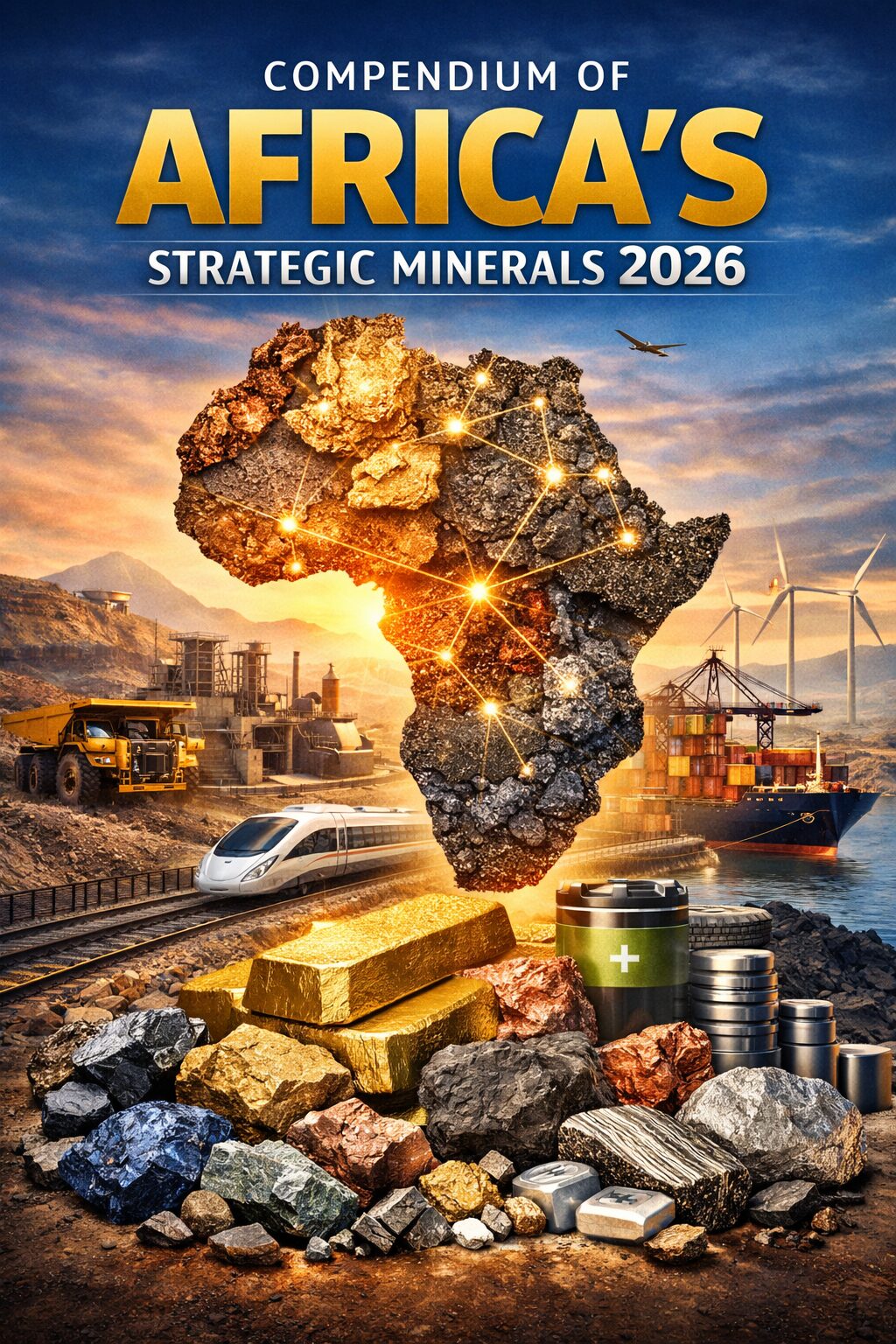
The Compendium of Africa’s Strategic Minerals 2026 reframes Africa’s mineral wealth from a simple inventory of resources into a coordinated, system-level economic strategy. Rather than viewing minerals as export commodities, the report positions them as catalysts for infrastructure development, industrialisation, and regional value-chain integration.
Africa’s mineral challenge is not scarcity—it is conversion. The continent must transform raw resources into power generation, rail corridors, industrial zones, digital infrastructure, and globally competitive processing hubs. Only when minerals are embedded in functional infrastructure systems and aggregated demand clusters can Africa unlock durable value capture.
According to estimates derived from the MinEx Global Deposits Database, Africa hosts approximately US$29.5 trillion in mine-site value, representing nearly 20% of global mineral wealth. Of this, US$8.6 trillion remains undeveloped—equivalent to roughly 2.5 times Africa’s annual GDP.
The opportunity is historic. The execution challenge is strategic.
Africa Must Deepen Its Geological Data Ecosystem
Despite hosting some of the world’s most diversified and strategically significant mineral reserves, Africa remains structurally under-explored. Large portions of its mineral potential remain latent due to limited geological mapping, inconsistent data quality, and fragmented information systems.
High-quality geological data reduces investment risk. It lowers capital costs, improves project bankability, and enhances investor confidence across the mining value chain. Institutions such as the Africa Finance Corporation (AFC) have therefore called for coordinated efforts between governments, regional institutions, and private-sector actors to strengthen Africa’s geological data infrastructure.
Mine-site values referenced in the Compendium reflect gross in-situ value at the mine gate—before processing, logistics, royalties, taxes, and operating costs. Improved geological transparency would allow the continent to better quantify risk, attract long-term capital, and accelerate project development.
Strategic priority: Standardised geological surveys, digitised mineral cadastres, and open-access data platforms.
Also Read: Top 10 African Countries With The Most Natural Resources
Beneficiation Works When Regional Demand Is Anchored
Mineral beneficiation across Africa remains uneven and often disconnected from downstream demand. Smelting or processing facilities cannot succeed in isolation. They must be embedded within regional industrial clusters where long-term demand fundamentals are strong.
Africa represents the world’s largest upside in future demand for:
-
Power infrastructure
-
Construction materials
-
Fertilisers and food inputs
-
Manufactured goods
-
Digital infrastructure
These sectors are mineral-intensive and create natural demand anchors.
Infrastructure and Construction
Railways, ports, bridges, and factories require:
-
Steel and ferro-alloys
-
Aluminium
-
Mineral sands
-
Fluorspar
With rapid urbanisation projected by the United Nations, demand for construction inputs is expected to rise significantly across the continent.
Energy Transition and Electrification
Bridging Africa’s energy deficit and participating in the global clean-energy transition requires:
-
Copper
-
Aluminium
-
Cobalt
-
Rare earth elements
-
Graphite
-
Silver
-
Uranium
The International Energy Agency (IEA) notes that critical mineral demand for clean energy technologies is projected to multiply several times over the next two decades.
Agriculture and Fertiliser Production
Achieving food self-sufficiency requires:
-
Phosphate
-
Potash
Africa’s fertiliser demand growth is tied directly to rising agricultural productivity and food security goals outlined by the African Development Bank.
Also Read: Top 10 Oil and Gas Exploration Companies in Africa: Key Players Driving the Continent’s Energy Sector
Digital Infrastructure and Electronics
The continent’s growing digital economy depends on:
-
Tin
-
Tantalum
-
Tungsten
-
Battery minerals
Automotive and Machinery
Both traditional and electric vehicles require:
-
Lead and platinum group metals (PGMs)
-
Lithium
-
Nickel
-
Rare earths
-
Manganese
-
Cobalt
-
Graphite
Beneficiation becomes commercially viable when linked to these structural demand clusters rather than export-oriented processing alone.
Infrastructure Is More Than an Enabler—It Defines Value Capture
Localising mineral supply chains is economically meaningful only when embedded within robust infrastructure systems. The economics of beneficiation are determined by:
-
Reliable and affordable power
-
Efficient rail and port logistics
-
Access to industrial land
-
Trade facilitation capacity
High power costs or unreliable logistics can erase beneficiation margins entirely.
The Compendium introduces a continent-wide minerals-and-infrastructure map that connects:
-
Operating mines
-
Undeveloped deposits
-
Rail corridors
-
Ports
-
Major power generation hubs
Strategic infrastructure corridors—such as those being developed under the African Continental Free Trade Area (AfCFTA) framework—can significantly enhance regional mineral value chains by lowering trade barriers and aggregating industrial demand.
Trade Realignment Is Elevating Africa’s Strategic Importance
Global mineral supply chains are under increasing strain due to:
-
Trade tensions
-
Export controls
-
Industrial policy shifts
-
Concentration risks
According to the World Trade Organization (WTO), geopolitical fragmentation is reshaping trade flows and prompting supply-chain diversification.
China currently dominates:
-
~90% of global manganese refining
-
~90% of rare earth separation and refining
-
Battery-grade graphite processing
Concentration risks also affect aerospace and defence supply chains, particularly for:
-
Chromium
-
Graphite
-
Rare earth elements
-
Tungsten
Meanwhile, uranium has re-emerged as a strategic mineral amid renewed nuclear momentum, as highlighted by the World Nuclear Association.
Africa’s Active Positioning
Africa is transitioning from latent potential to strategic execution:
-
Angola is constructing the continent’s first rare earth refinery.
-
Mozambique is emerging as a major supplier to non-China graphite and anode supply chains.
-
South Africa and Botswana are advancing battery-grade manganese sulphate projects.
-
Uranium production has resumed in Namibia (2024) and Malawi (2025).
These developments position Africa as a diversification partner in strategically sensitive mineral supply chains.
Gold: A Strategic Tool for Reserve Accumulation
Gold offers a uniquely pragmatic opportunity for African economies facing foreign currency constraints.
Africa hosts over US$5 trillion in gold mine-site value, including more than US$1 trillion in untapped deposits. Yet gold accounts for only about $70 billion of Africa’s external reserves, roughly 15% of total FX reserves, according to estimates from the International Monetary Fund (IMF).
Unlike most minerals, gold provides:
-
Deep global liquidity
-
Transparent pricing
-
Rapid monetisation
-
Direct conversion into reserves
By integrating domestic gold production into reserve accumulation strategies, countries can strengthen external buffers while formalising artisanal and small-scale mining sectors.
Gold, therefore, becomes both a macroeconomic stabiliser and a structural development tool.
The Central Message: Minerals Must Be Embedded in Systems
Africa’s mineral wealth becomes transformative only when integrated into:
-
Functional infrastructure ecosystems
-
Aggregated regional demand
-
Coordinated industrial clusters
-
Strategic trade positioning
The objective is not indiscriminate export expansion. It is selective positioning where Africa can improve project economics, enhance supply-chain resilience, and secure durable participation in both regional and global value chains.
The Compendium of Africa’s Strategic Minerals 2026 makes one conclusion unmistakable:
Africa’s mineral future will not be determined by geology alone—but by coordination, infrastructure, and strategic execution.
With $8.6 trillion in undeveloped assets waiting to be activated, the continent stands at a defining inflection point.