
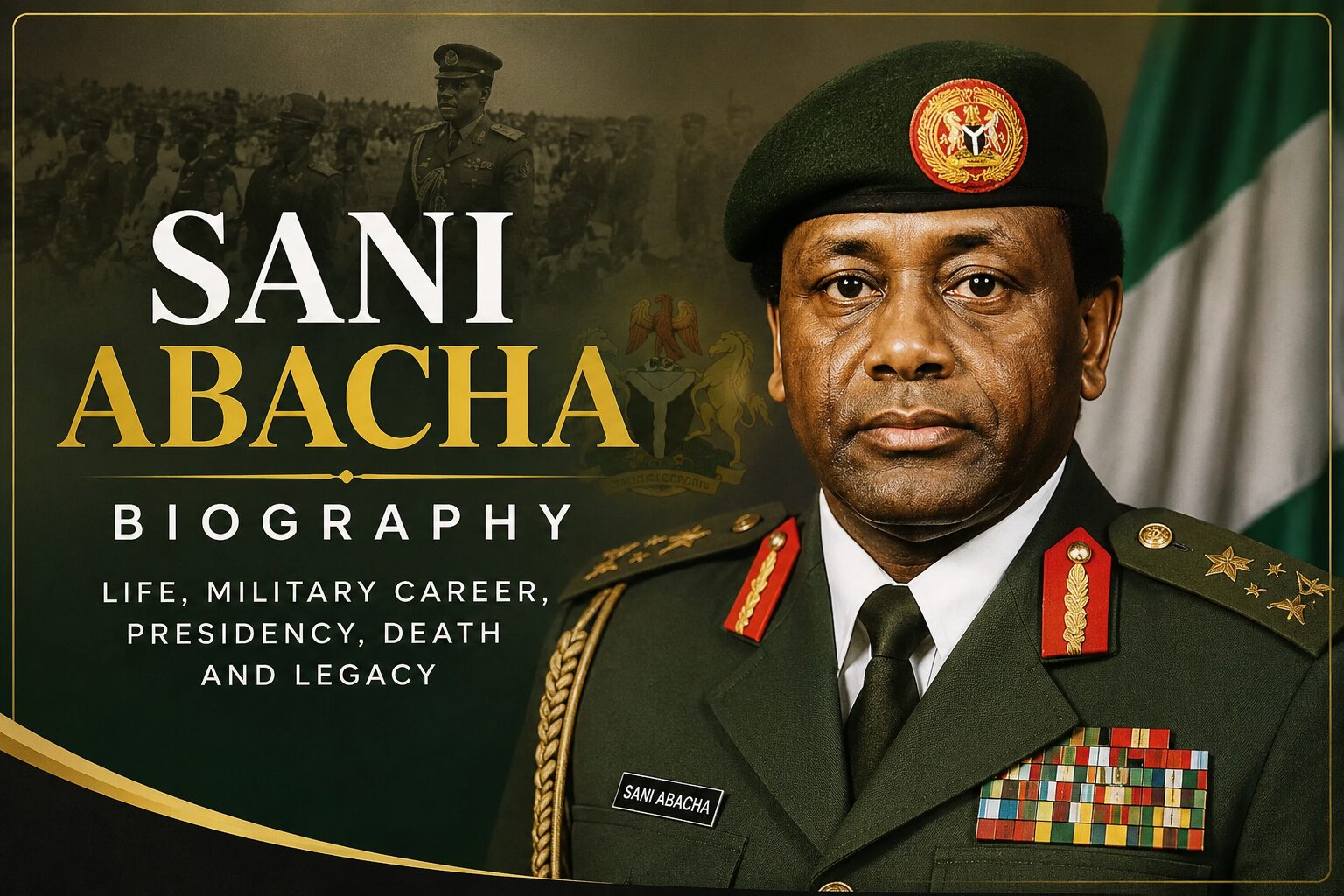
General Sani Abacha remains one of the most influential and controversial figures in Nigerian history. As Nigeria’s military Head of State from 1993 to 1998, Abacha presided over a period marked by economic reforms, political repression, international isolation, and significant national debate.
More than two decades after his death, opinions about Abacha remain deeply divided. Some Nigerians remember him as a strong leader who maintained stability and strengthened the country’s foreign reserves, while others view his administration as one of the most authoritarian periods in modern Nigerian history.
This biography explores the life, military career, presidency, achievements, controversies, death, and enduring legacy of Sani Abacha.
Early Life and Education
Sani Abacha was born on September 20, 1943, in Kano, Northern Nigeria. He came from a respected family of Kanuri descent and grew up during the final years of British colonial rule in Nigeria.
He attended the Provincial Secondary School in Kano before joining the Nigerian Military Training College in Kaduna in 1962. His military education continued abroad at the Mons Officer Cadet School in England and later at various military institutions.
Abacha’s military training laid the foundation for a career that would eventually place him at the center of Nigerian politics for more than three decades.
Military Career
Abacha was among the first generation of officers in the post-independence Nigerian Army. His rise through the military ranks was rapid and notable.
He participated in the Nigerian Civil War (1967–1970), during which he gained significant operational experience.
Throughout the 1970s and 1980s, Abacha became increasingly influential within the Nigerian military establishment. Remarkably, he was involved in nearly every successful military coup in Nigeria between 1966 and 1993.
He played important roles in:
The 1983 Coup
Abacha supported the military coup that removed President Shehu Shagari and brought General Muhammadu Buhari to power.
The 1985 Coup
He also played a critical role in the coup that replaced Buhari with General Ibrahim Babangida.
Minister of Defence
Under Babangida’s administration, Abacha served as Chief of Army Staff and later Minister of Defence, becoming one of the most powerful figures in the Nigerian military hierarchy.
The Political Crisis of 1993
Nigeria entered one of its most turbulent political periods in 1993.
The June 12 presidential election, widely regarded as Nigeria’s freest election, was won by Moshood Kashimawo Olawale (M.K.O.) Abiola. However, the election results were annulled by the Babangida administration.
The annulment triggered widespread protests and political instability.
In an attempt to resolve the crisis, Babangida handed power to an Interim National Government led by Ernest Shonekan.
The arrangement lasted only three months.
On November 17, 1993, Sani Abacha seized power in a bloodless coup and became Head of State of Nigeria.
Sani Abacha as Head of State
Upon assuming power, Abacha dissolved democratic institutions, suspended parts of the constitution, and consolidated authority under military rule.
His government established the Provisional Ruling Council, which became the highest decision-making body in the country.
Abacha promised a transition to civilian rule but maintained tight political control throughout his administration.
Economic Policies and Achievements
Supporters of Abacha frequently point to several economic accomplishments during his tenure.
Growth in Foreign Reserves
Nigeria’s foreign reserves reportedly increased significantly during his administration, supported by strong oil revenues.
Reduced External Debt
The government made substantial repayments on Nigeria’s external debt obligations.
Infrastructure Development
Several road projects, petroleum facilities, and public infrastructure programs were initiated or expanded during his rule.
Petroleum Sector Expansion
As a major oil-producing nation, Nigeria experienced increased petroleum production and revenue generation during the Abacha years.
Improved National Security
Supporters argue that crime and political unrest were more tightly controlled under his government.
Human Rights Controversies
Abacha’s administration faced widespread criticism from human rights organizations and foreign governments.
Political opponents, journalists, labor activists, and pro-democracy campaigners were frequently detained.
Many critics accused the government of suppressing dissent and restricting freedom of expression.
Several prominent opposition figures were imprisoned during this period, including M.K.O. Abiola, who continued to claim victory in the June 12 election.
The Execution of Ken Saro-Wiwa
One of the defining moments of Abacha’s presidency occurred in 1995.
Environmental activist and writer Ken Saro-Wiwa, along with eight other Ogoni activists, was executed after being convicted by a special military tribunal.
The executions generated international condemnation.
As a result, Nigeria was suspended from the Commonwealth, and relations with several Western countries deteriorated significantly.
The incident remains one of the most debated aspects of Abacha’s rule.
Corruption Allegations
Following Abacha’s death, investigations revealed that billions of dollars had allegedly been diverted from public funds during his administration.
Over the years, multiple countries, including Switzerland, the United Kingdom, and the United States, have cooperated with Nigerian authorities to recover assets linked to the Abacha family and associates.
These recovered funds became widely known as “Abacha Loot.”
The recovery process continues to attract public attention and legal scrutiny.
Foreign Relations
Abacha’s government experienced increasing international isolation.
Nigeria faced diplomatic pressure from several Western nations over human rights concerns and the execution of political opponents.
Despite these tensions, Nigeria maintained strategic relations with various African, Middle Eastern, and Asian countries.
The country also continued to play a significant role in regional peacekeeping operations through ECOWAS.
Death of Sani Abacha
On June 8, 1998, Sani Abacha died suddenly at the Presidential Villa in Abuja.
He was 54 years old.
The official announcement stated that he died of a heart attack.
His unexpected death shocked Nigeria and immediately altered the country’s political trajectory.
Following his death, General Abdulsalami Abubakar assumed power and initiated a transition program that eventually led to democratic elections in 1999.
Family and Personal Life
Sani Abacha was married to Maryam Abacha and had several children.
Despite his public image as a military ruler, he maintained a relatively private family life.
Members of the Abacha family have remained active in business, philanthropy, and public affairs since his death.
Legacy
The legacy of Sani Abacha remains highly contested.
Supporters argue that he strengthened Nigeria’s economy, improved national security, reduced external debt, and maintained political stability.
Critics emphasize allegations of corruption, human rights abuses, political repression, and the execution of dissidents.
Historians generally regard Abacha as one of the most consequential leaders in Nigeria’s post-independence history.
His administration continues to shape discussions about governance, democracy, military rule, accountability, and economic management in Nigeria.
Frequently Asked Questions
Who was Sani Abacha?
Sani Abacha was a Nigerian military officer who served as Nigeria’s Head of State from 1993 until his death in 1998.
When was Sani Abacha born?
He was born on September 20, 1943, in Kano, Nigeria.
How did Sani Abacha become president?
He seized power in a bloodless military coup on November 17, 1993, following the collapse of the Interim National Government.
When did Sani Abacha die?
He died on June 8, 1998, in Abuja, Nigeria.
Why is Sani Abacha controversial?
His administration is remembered for both economic achievements and allegations of corruption, political repression, and human rights violations.
Conclusion
Sani Abacha remains one of the most discussed figures in Nigerian history. His years in power left a lasting impact on the country’s political, economic, and social landscape. Whether viewed as a stabilizing leader or an authoritarian ruler, his influence on Nigeria’s modern history cannot be ignored. Understanding Abacha’s life and legacy provides valuable insight into Nigeria’s journey through military rule and its transition toward democracy.