
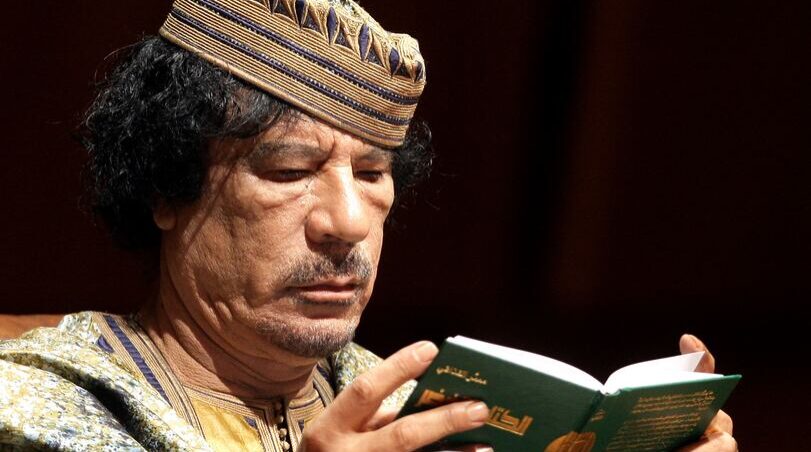
Africa Facts Zone presents a complete guide to The Green Book, the influential political manifesto written by Muammar Gaddafi. First published in 1975, the book outlines Gaddafi’s unique ideology known as the Third International Theory, offering an alternative to capitalism, communism, and representative democracy.
For decades, The Green Book shaped Libya’s political system, education, and national identity. However, during the Libyan Civil War, copies of the book were publicly destroyed by anti-Gaddafi protesters, symbolizing the collapse of his regime.
What Is The Green Book of Gaddafi?
The Green Book is a 110-page political philosophy text divided into three parts focusing on:
- Democracy
- Economics
- Social structure
Gaddafi rejected Western-style democracy, arguing that elections and parliaments do not truly represent the people. Instead, he proposed a direct democracy system, where citizens govern themselves through local committees.
The Influence of The Green Book in Libya
The book wasn’t just theory—it was deeply embedded in everyday life in Libya:
- Students studied it weekly in schools
- Its ideas were broadcast on national TV and radio
- Quotes appeared on billboards and buildings
By the 1990s, The Green Book had gained international attention, with lectures held across Europe, Africa, and Latin America.
Also Read: A Biography about Nelson Mandela
Contents of The Green Book (Explained)
1. The Solution to the Problem of Democracy (1975)
“The Authority of the People”
This section criticizes modern democracy:
- Parliaments are seen as undemocratic
- Political parties are viewed as tools of division
- Elections are considered misleading
Gaddafi instead promotes direct popular rule, where citizens participate directly in governance.
2. The Solution to the Economic Problem (1977)
“Socialism”
In this section, Gaddafi presents his economic ideas:
- Workers should own the fruits of their labor
- Wage labor is a form of exploitation
- Wealth should be distributed equally
He advocates for a system where economic power is shared among the people rather than concentrated in corporations or elites.
3. The Social Basis of the Third International Theory (1981)
This part explores:
- Family and societal roles
- Education systems
- Cultural identity
- Gender dynamics
It expands beyond politics into social philosophy, making it one of the most debated sections of the book.
Key Ideas from The Green Book
Direct Democracy
Gaddafi argued that true democracy can only exist when people participate directly—not through elected representatives.
Freedom of Expression
The book states that:
Freedom of expression is a natural right of every individual
However, it also argues that media should be publicly owned, not privately controlled, to prevent manipulation.
Abolition of Money and Profit
One of the most radical ideas in The Green Book is the elimination of money:
- Society becomes fully productive
- Citizens’ needs are met
- Profit becomes unnecessary
This vision reflects a highly idealistic form of socialism.
Why The Green Book Still Matters Today
Even years after Gaddafi’s fall, The Green Book remains relevant for:
- Understanding Libyan political history
- Studying alternative governance systems
- Analyzing African political ideologies
Also Read: Libya Facts, History, Culture & Travel
Final Thoughts
The Green Book by Muammar Gaddafi remains one of the most controversial political texts in modern history. Whether viewed as revolutionary or unrealistic, it offers a unique perspective on governance, economics, and society.
| Part | Chapter | Title | Summary |
|---|---|---|---|
| I | 1 | The Instrument of Government |
The most significant political question is “what type of government ought to be laid out?” Such an administration ought to be an immediate majority rules system, however what typically happens is that delegate popular governments are laid out, which usurp the desire of large populaces who didn’t decide in favor of existing states, utilizing first-past-the-post constituent frameworks. |
| 2 | Parliaments |
The essential component of a representative democracy is its parliament. Once choseen, individuals usurp the power of their constituents for their term of administration. |
|
| 3 | The Party |
Political parties themselves additionally seize individuals’ position, and spotlight on keeping up with power as opposed to further developing society for all, the appropriate object of government. More terrible, ideological groups are vulnerable to debasement. |
|
| 4 | Class |
Society is parted into classes: political, social, or tribal groups. A class which secures political power, likewise acquires the general public wherein that power is gained. A previous middle class ultimately turns into the new decision class. The issue of a majority or minority managing the whole society perseveres. |
|
| 5 | Plebiscites |
Plebiscites or referenda are not a proper answer for the political problem. One’s political assessment doesn’t decrease to a yes-or-no vote. |
|
| 6 | Popular Conferences and People’s Committees |
The answer for the issue of a vote based system is to lay out a progression of Popular Conferences (or, Congresses) and People’s Committees, which by and large comprise of the whole society, and its areas. Cooperating, these groups displace government organization, with the support of all. These groups are likewise not parliaments in which authority is delegated. |
|
| 7 | The Law of Society |
The premise of regulation is in custom and religion, the genuine wellspring of social guideline, and not in composed constitutions. The very reality that constitutions are routinely corrected is a proof of their shortcoming and brevity as an instrument of government. |
|
| 8 | Who Supervises the Conduct of Society? |
Just as political power ought not be designated to representatives, policing power additionally ought not be appointed away from the whole society. Once more, the construction of Conferences and Committees is the arrangement. The Whole is the council for the Whole, and the Whole is the policing the Whole. |
|
| 9 | How can Society Redirect its Course when Deviations from its Laws occur? |
In the situation where a minority runs an administration, one more minority with drive might hold onto power through revolution, with the final product being something similar: minority rule. The answer for this cycle is again the arrangement of Conferences and Committees: the whole society naturally administering itself. At the point when this happens, there is just a Whole, and hence no outside foe to battle. |
|
| 10 | The Press |
While people and organizations reserve the privilege to put themselves out there in a confidential limit, “the press” for the purpose of articulation for society should be issued by the Conferences and Committees. If not, people would again seize power away from others in the domain of thoughts. |
|
| II | 11 | The Economic Basis of the Third Universal Theory |
Recent improvements in working life, for example, associations and the lowest pay permitted by law don’t go far sufficient in that frame of mind for all workers. What is required is the nullification of blue collar for a “cooperating” interaction of a singular worker with a given industry. Yields should be shared similarly among people, yet among all parts of a production process. |
| 12 | Need |
Need is a focal monetary issue. The necessities of some might be gone after by the people who possess the ability to give, and accordingly exploit. Government ought to dispose of such abuse. |
|
| 13 | Housing |
The rental of housing, for instance, is exploitation, and infringes the freedom of the renter. In a perfect world, everybody ought to have just a single house, since, because if a given party has more than one property, they will be inclined to rent it, thereby exploiting their renters. |
|
| 14 | Income |
Individual income is vital for an economy. Once more, such pay ought not be acknowledged as wages paid by a owner, yet as the aftereffect of organization in an industry. |
|
| 15 | Means of Transportation |
Transportation ought to likewise be accessible to all, and simultaneously not possessed by some just to be leased to other people, as on account of taxi services. |
|
| 16 | Land |
Land, similar to all of the previously mentioned classifications, ought to be similarly accessible to all. As a general rule, parts of the economy ought to in this way be conveyed similarly among all, to deliver fairness of result. Nobody has the privilege to put something aside for themselves past their own requirements, except up to their own arithmetic share of a given good among the whole population. |
|
| 17 | Domestic Servants |
Like products delivering workers, administration delivering homegrown workers are actually slaves. The financial model previously outlined can likewise be applied to their circumstance. |
|
| III | 18 | The Social Basis of the Third Universal Theory |
Individuals, families, clans and countries are social units, and their social ties drive the course of history. Of these, the country is a focal unit, kept intact by patriotism. Similarly as the sun would disseminate without gravity, countries disperse without public solidarity. |
| 19 | The Family |
Families, people and countries are regular, objective human social classifications, on a continuum. Opposed to these is the artificial modern construct of the state, distinct from a nation. |
|
| 20 | The Tribe | Apart from the family, the next biggest human group level is the tribe. The different human social units are decreasingly vital to people on an individual level, as their size increments. | |
| 21 | The Merits of the Tribe |
Tribes are established in blood, provide social cohesion, able to internally monitor themselves due to their numbers. They likewise guarantee the socialization of their people, training more valuable than a school education. |
|
| 22 | The Nation |
Again, patriotism is a focal social classification, one firmly connected with however particular from other enormous scope social classifications: religions, states, and domains. The justification for why states and domains change and fall is a result of their incongruence with true countries. |
|
| 23 | Woman |
Women and men are equivalent as people, as in they have similar physiological necessities, and are thinking and feeling creatures. Nonetheless, sexual dimorphism brings about orientation jobs which are normal and suitable to the distinctions between the genders. Opportunity comprises in following nature, explicitly in ladies being able to raise families without being constrained by society to look for work which is reasonable just for men. |
|
| 24 | Minorities |
Minorities are of two sorts: those previously having a country, and those having none, making their own. One way or another, their freedoms should be secured. |
|
| 25 | Black People will Prevail in the World |
Black people are ready to rule the human populace in light of the fact that their way of life incorporates polygamy and disregards birth control, and in light of the fact that they live in an environment which is “consistently hot”, with the outcome that work is less significant for them than in different societies. |
|
| 26 | Education |
Formal school training is authoritarian, one more oppression like those recorded previously. Education should be made available in whatever fashion people wish to engage with it. |
|
| 27 | Music and Art |
Humans ought to ultimately communicate in one language. Creative and social preferences are affected by contrasts in language, and the previous engraving themselves “on the qualities” of the person. |
|
| 28 | Sport, Horsemanship and the Stage | Spectatorship in sports, theater and other entertainments is foolish. People should engage in sports directly, deriving the benefits of athletics for themselves, rather than standing by and watching others perform. |
FAQ
What is The Green Book of Gaddafi about?
It explains Gaddafi’s political ideology, rejecting capitalism and democracy in favor of direct rule by the people.
How many pages is The Green Book?
The book contains approximately 110 pages divided into three sections.
What is the Third International Theory?
It is Gaddafi’s alternative political system combining elements of socialism, nationalism, and direct democracy.
Why was The Green Book banned or destroyed?
During the Libyan Civil War, protesters rejected Gaddafi’s ideology and publicly destroyed copies.
Download a copy
Source Credit: openanthropology.org