
When people think of Britain, the images that often come to mind include tea, crumpets, and the grandeur of the monarchy. Yet beneath this polished veneer lies a past built upon exploitation, violence, and colonial domination.
The British Empire, once the largest empire in history, controlled nearly a quarter of the world’s landmass and population. But the human cost of this dominance has long been buried under layers of historical amnesia.
The Myths of Empire and Historical Amnesia
For decades, British imperial history has often been painted with nostalgia. School curricula in the UK largely omit the atrocities of colonial rule, presenting the empire as a story of progress and modernization. However, historians and researchers have shown that this selective memory is misleading. The wealth that fueled Britain’s industrial revolution was largely financed through exploitation, extraction, and mass suffering across the colonies (BBC)
The Plunder of India
One of the most devastating examples of imperial exploitation is India. Between 1765 and 1938, Britain is estimated to have drained nearly $45 trillion from the Indian economy (The Guardian)
During British rule, engineered famines and forced exports contributed to the deaths of more than 29 million Indians. Famines such as the Bengal famine of 1943, exacerbated by wartime policies under Winston Churchill, left lasting scars that remain part of India’s collective memory today (History Extra)
Colonial Atrocities in Africa
The empire’s reach in Africa was no less brutal. In Kenya during the 1950s, the colonial government established a system of detention camps to suppress the Mau Mau uprising.
Reports revealed mass beatings, torture, castrations, and deaths from starvation and disease. Historian David Anderson has compared these camps to those run by the Nazis. Before Britain’s exit, officials even burned and dumped records at sea to erase evidence of crimes (The Guardian)
The Transatlantic Slave Trade
Britain was also one of the leading powers in the transatlantic slave trade, which forcibly transported millions of Africans to the Americas between the 16th and 19th centuries. Enslaved people were traded for manufactured goods and shipped under brutal conditions, fueling the empire’s wealth through plantations in the Caribbean and Americas (Britannica)
By the 18th century, British merchants dominated the trade, with cities like Liverpool and Bristol becoming central hubs. The profits from slavery built industries, funded banks, and left an economic legacy that Britain still benefits from today (University College London – Legacies of British Slavery
Also Read: The Slave Trade in Africa: The Atlantic Slave Trade
Whitewashed Symbols and Legacy
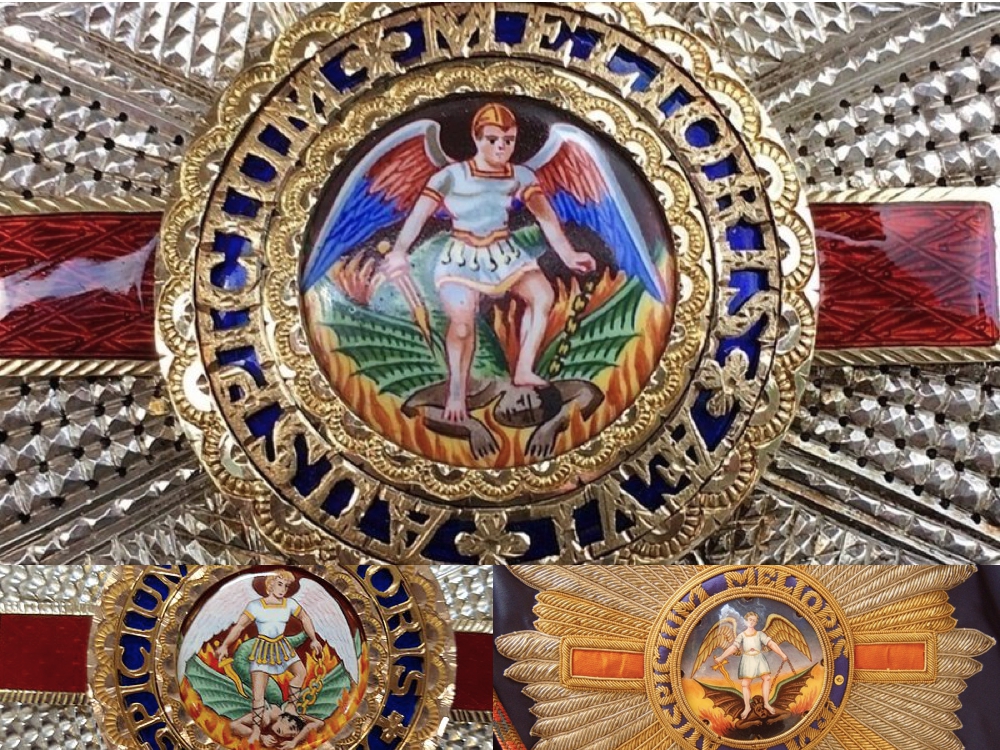
Even Britain’s highest imperial honors reflect racial dominance. The Order of St. Michael and St. George depicts the archangel standing on the neck of a dark-skinned figure, an image disturbingly reminiscent of modern-day racial violence. This symbolism, embedded within the empire’s culture, reveals how deeply the notion of white superiority was woven into imperial institutions.

The Ongoing Debate
Figures like Winston Churchill are celebrated as war heroes in Britain but remain controversial for their racist views and policies that contributed to famine and suffering in the colonies.
Across the former empire, the consequences of colonial rule continue to shape political, social, and economic realities. From India and Kenya to Palestine and the Caribbean, partition, poverty, and unrest can often be traced back to British imperialism.
Britain and the Transatlantic Slave Trade
The Asiento de Negros, signed in 1713, gave Britain the exclusive right to supply Spain’s colonies with enslaved Africans—up to 4,800 enslaved people per year for 30 years. This contract was awarded to the South Sea Company, in which Queen Anne herself held a significant stake (National Archives UK).
By the 17th century, the demand for enslaved labor skyrocketed with the growth of sugar plantations in the Caribbean and tobacco fields in North America. The 18th century saw the largest forced migration of Africans across the Atlantic. Historians estimate that nearly 60% of all enslaved Africans transported during the transatlantic slave trade made the journey during this century (UNESCO Slave Route Project).
The infamous Middle Passage was marked by unspeakable brutality. Africans were chained, confined in suffocating conditions, and deprived of basic human needs. Mortality rates were staggering, with 15–25% dying en route due to disease, suffocation, or abuse (Britannica).
Although Britain abolished slavery in 1833 and deployed its navy to suppress the trade, the damage was already incalculable. Beyond the human suffering, the trade devastated African societies by depopulating regions, fostering conflict, and disrupting economies. A disproportionate number of young men and women—the backbone of future generations—were lost (BBC History).
Also Read: How Africans Were Lured into the First Slave Ship’ Jesus of Lubeck
The Mau Mau Uprising in Kenya
Britain’s colonial brutality extended far beyond slavery. In Kenya during the 1950s, the Mau Mau uprising highlighted the deep grievances of the Kikuyu people, who had been dispossessed of their land and forced into low-wage labor on European farms. What began as a demand for land and independence escalated into an armed struggle against colonial authorities (Encyclopedia Britannica).
The British response was ruthless. Over 1.5 million Kikuyu civilians were herded into detention camps or fortified villages, where torture, rape, starvation, and executions became routine. Even prominent families, such as former U.S. President Barack Obama’s Kenyan grandfather, suffered severe abuse in these camps (The Guardian).
Official British records claimed only 80,000 detainees, but later declassified documents revealed that nearly the entire Kikuyu population was imprisoned. The death toll remains uncertain, though estimates suggest that over 100,000 Kenyans were killed (BBC News).
In 2013, after years of legal battles, the UK government finally agreed to a settlement. Then-Foreign Secretary William Hague expressed “sincere regret,” and around 5,000 survivors received £3,800 each in compensation. However, many argue this was a fraction of what justice demanded (UK Parliament).
The Partition of India: A Wound That Still Bleeds
Another enduring legacy of British rule is the Partition of India in 1947, which created the two nations of India and Pakistan. Ostensibly drawn along religious lines, the division was hastily executed, poorly planned, and devastating in its human cost (History Today).
The partition triggered mass violence and forced migration on an unprecedented scale. Up to 15 million people were displaced, and as many as 1 million were killed in sectarian massacres between Hindus, Muslims, and Sikhs (BBC News).
The political fallout of partition remains unresolved. The dispute over Kashmir, left divided in 1947, has led to multiple wars and remains a flashpoint for conflict between India and Pakistan (Council on Foreign Relations).
Partition was not simply a local event—it was a direct consequence of Britain’s hasty withdrawal and its divide-and-rule policies. Today, its legacy continues to shape South Asian geopolitics and the lives of millions.
The Anglo-Zulu War: Britain’s Bloody Campaign Against Zululand
The Anglo-Zulu War of 1879 remains one of the most infamous chapters of British colonial expansion in southern Africa. Lasting from January 11 to July 4, the conflict pitted the British Empire against the proud and independent Zulu Kingdom, led by King Cetshwayo. What began as a political maneuver to secure labor for diamond fields and integrate Zululand into a British-controlled South African federation soon escalated into one of the bloodiest wars of the colonial era.
Also Read: Shaka Zulu’ South Africa’s Greatest Army General
The Background: Britain’s Imperial Ambitions
By the late 19th century, Britain sought to consolidate power in southern Africa. Inspired by the British North America Act of 1867, which had unified Canada into a federation, policymakers such as Lord Carnarvon envisioned a similar structure in South Africa. This federation, however, would rest on the subjugation of African kingdoms and the Boer republics, ensuring access to cheap labor for sugar plantations and mines (British Library).
In 1874, Sir Bartle Frere was dispatched to South Africa as High Commissioner to implement these plans. One major obstacle stood in the way: the Zulu Kingdom, a militarized society with a formidable army of nearly 60,000 men under King Cetshwayo. When Frere issued an ultimatum in December 1878 demanding the dismantling of the Zulu military system, the king refused.
The Battles: Isandlwana and Rorke’s Drift
On January 11, 1879, British forces under Lord Chelmsford invaded Zululand. The campaign quickly escalated into a series of legendary battles.
-
Battle of Isandlwana (January 22, 1879): Despite their advanced weaponry, the British suffered a catastrophic defeat. Over 1,300 soldiers were killed by a Zulu force of around 20,000 led by Ntshingwayo kaMahole. Historians often compare this loss to Custer’s defeat at Little Bighorn (1876) in the United States (History Today).
-
Battle of Rorke’s Drift (later the same day): In a dramatic reversal, just 140 British troops under John Chard and Gonville Bromhead held off 4,000 Zulu warriors. The defense earned the British 11 Victoria Crosses, though it overshadowed the Zulu’s courageous resistance.
The Fall of Zululand
The war culminated in the Battle of Ulundi on July 4, 1879. Around 20,000 Zulus were killed, followed by the capture of King Cetshwayo. The monarchy was dismantled, Zululand divided into chieftainships, and in 1887 it was formally declared a British territory—later annexed to Natal in 1897 (BBC Bitesize).
The Legacy: Loss, Trauma, and Cultural Survival
The consequences for the Zulu people were devastating:
-
Loss of land and sovereignty – Zululand was absorbed into the colonial state.
-
Economic exploitation – Zulus were forced into cheap labor for British industries.
-
Cultural suppression – Traditional governance and military structures were dismantled.
-
Intergenerational trauma – The legacy of violence and displacement endures.
Today, the Zulu nation continues to reclaim cultural identity and seek recognition for the historical injustices imposed during this period (South African History Online).
Conclusion: The Long Shadow of Empire
From the rolling hills of Zululand to the starving villages of Biafra, the scorched earth of the Boer republics, and the blood-soaked grounds of Amritsar, the legacy of British imperialism is one written in conquest, division, and tragedy. These events were not isolated incidents, but interconnected expressions of a global strategy—one that prioritized economic gain and imperial dominance over human life, dignity, and sovereignty.
The consequences were profound: dispossession of indigenous lands, suppression of cultural identities, mass displacement, economic exploitation, and intergenerational trauma. Entire nations were reshaped, and communities left fractured in ways still felt today.
Yet, history also reveals resilience. The Zulu people continue to preserve and celebrate their heritage. Survivors of the Biafran War keep alive the memory of those lost, demanding justice and remembrance. South Africa’s struggle against colonial and apartheid systems forged a path toward liberation, while India transformed the pain of Amritsar into fuel for its independence movement.
Understanding these histories is not merely about recounting past atrocities. It is about recognizing how colonial systems continue to influence present inequalities—and why global efforts toward reconciliation, redress, and cultural revival remain so critical.
In remembering the victims and honoring the resistance of oppressed peoples, we are reminded that empires may fall, but the quest for justice and dignity endures.