
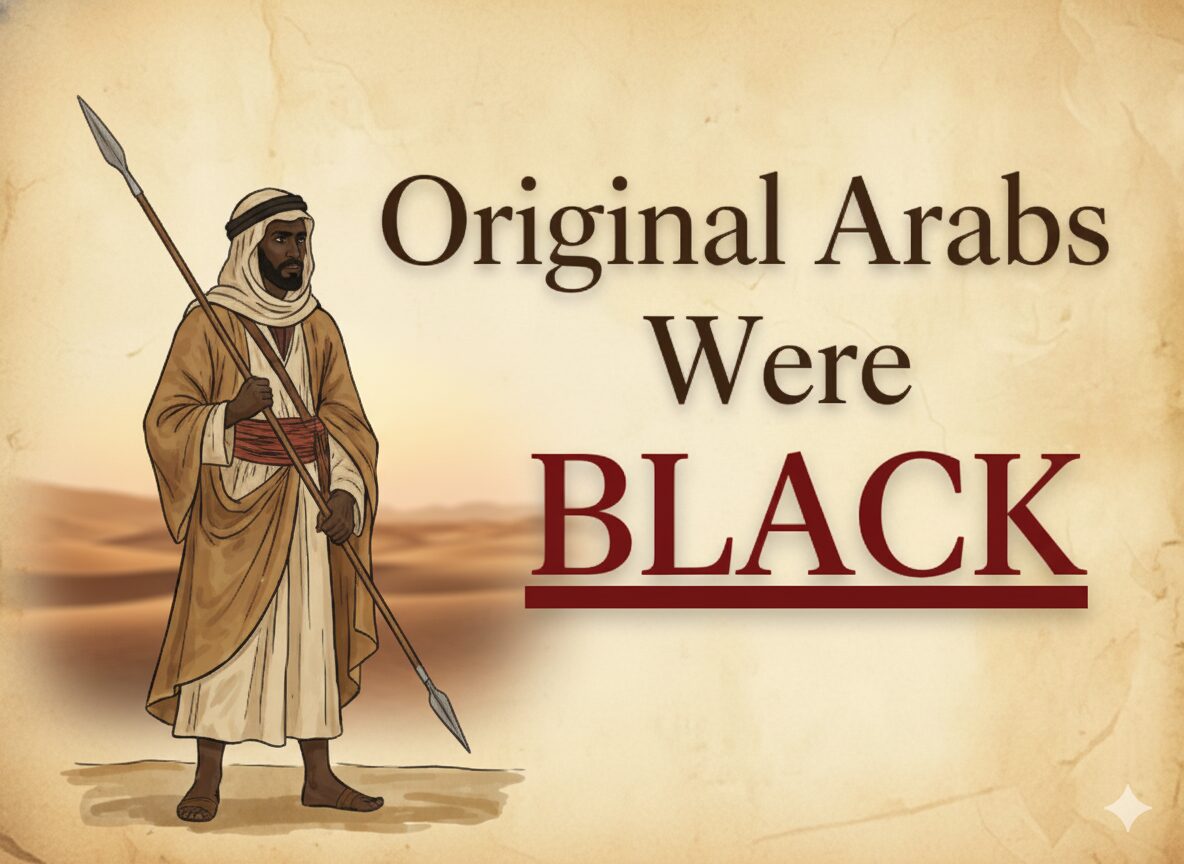
The question of whether the original Arabs were Black has sparked intense debate in history, anthropology, and cultural studies. While modern perceptions often portray Arabs in a specific way, ancient records, genetic research, and early writings tell a far more complex story.
Long before modern borders existed, the Arabian Peninsula was a crossroads between Africa and Asia. Early populations in the region were deeply connected to African groups, particularly those from the Horn of Africa and the Nile Valley.
This article explores the historical, archaeological, and scientific evidence that sheds light on the origins of early Arab populations.
Ancient Historical Accounts of Early Arabs
One of the strongest pieces of evidence comes from ancient historians.
The Greek historian Herodotus described populations in and around Arabia as dark-skinned and closely related to Ethiopians in his work The Histories. The term he used, Aithiops, referred broadly to dark-skinned peoples living south of Egypt and across regions including parts of Arabia.
Similarly, the Roman geographer Strabo noted strong physical and cultural similarities between people living on both sides of the Red Sea in his work Geographica.
These accounts suggest that ancient observers viewed southern Arabia and parts of Africa as part of a connected cultural and physical zone.
Arabia and Africa: A Shared Ancient World
Geographically, Arabia and Africa are separated by the narrow Red Sea—only a short distance in many places. For thousands of years, this allowed continuous migration, trade, and cultural exchange.
Modern research supports this connection.
Studies published in journals like the American Journal of Physical Anthropology show genetic links between populations in Yemen and Ethiopia.
These studies reveal repeated migration between Africa and Arabia, not a one-time event.
Genetic Evidence Linking Arabs and Africans
Genetic research has reinforced what ancient historians observed.
Mitochondrial DNA studies show shared maternal lineages between populations in:
- Yemen
- Ethiopia
- Eritrea
This confirms that early populations in southern Arabia were closely related to African groups.
Early Islamic Scholars on Arab Identity
Early Arab scholars themselves acknowledged the diversity in Arab appearance.
The famous writer Al-Jahiz discussed similarities between Africans and Arabs, emphasizing that darker skin was natural in regions shaped by climate.
Likewise, the historian Ibn Khaldun explained that climate influenced skin color across regions, including Arabia.
These were not modern reinterpretations—they were observations from within Arab society itself.
Also Read: Are Egyptians Africans? Who exactly are the Egyptians—Arabs or Africans?
The Southern Arab Kingdoms and African Connections
Before Islam, powerful kingdoms existed in southern Arabia, including the Kingdom of Saba.
This civilization controlled major trade routes linking:
- Arabia
- East Africa
- The Mediterranean
There were also strong ties with the Kingdom of Aksum in present-day Ethiopia and Eritrea.
Archaeological findings show shared inscriptions, architecture, and trade networks across the Red Sea.
Famous Black Arab Figures in Early History
One notable example is Antarah ibn Shaddad, a celebrated warrior and poet of mixed Arab and Ethiopian heritage.
He was widely respected and became a symbol of courage and honor in Arab culture.
His story shows that darker-skinned individuals were not outsiders—they were part of the core Arab identity.
How the Image of Arabs Changed Over Time
If early Arabs were often described as dark-skinned, why does modern perception differ?
Several factors contributed:
1. Migration and Mixing
New populations entered Arabia from northern regions, introducing lighter skin tones.
2. Expansion of Islamic Empires
Intermarriage with people from Persia, Central Asia, and Europe gradually changed appearances in some regions.
3. Social Hierarchies
Over time, darker skin became unfairly associated with slavery due to the trans-Saharan and Indian Ocean slave trades.
4. Colonial Influence
European racial theories classified Arabs as “Caucasian,” reshaping global perceptions.
Modern Evidence Still Reflects the Past
Even today, many communities in:
- Yemen
- Oman
- Saudi Arabia
- Sudan
retain features that reflect these deep historical connections with Africa.
These populations serve as living evidence of Arabia’s diverse and interconnected past.
Final Thoughts
The idea that the original Arabs were Black is supported by:
- Ancient historical accounts
- Genetic research
- Archaeological findings
- Early Arab scholarship
Rather than a single identity, early Arab populations were part of a broader Afro-Arab world shaped by geography, migration, and shared history.
Understanding this history helps correct oversimplified narratives and highlights the rich diversity that has always existed in the Arab world.