
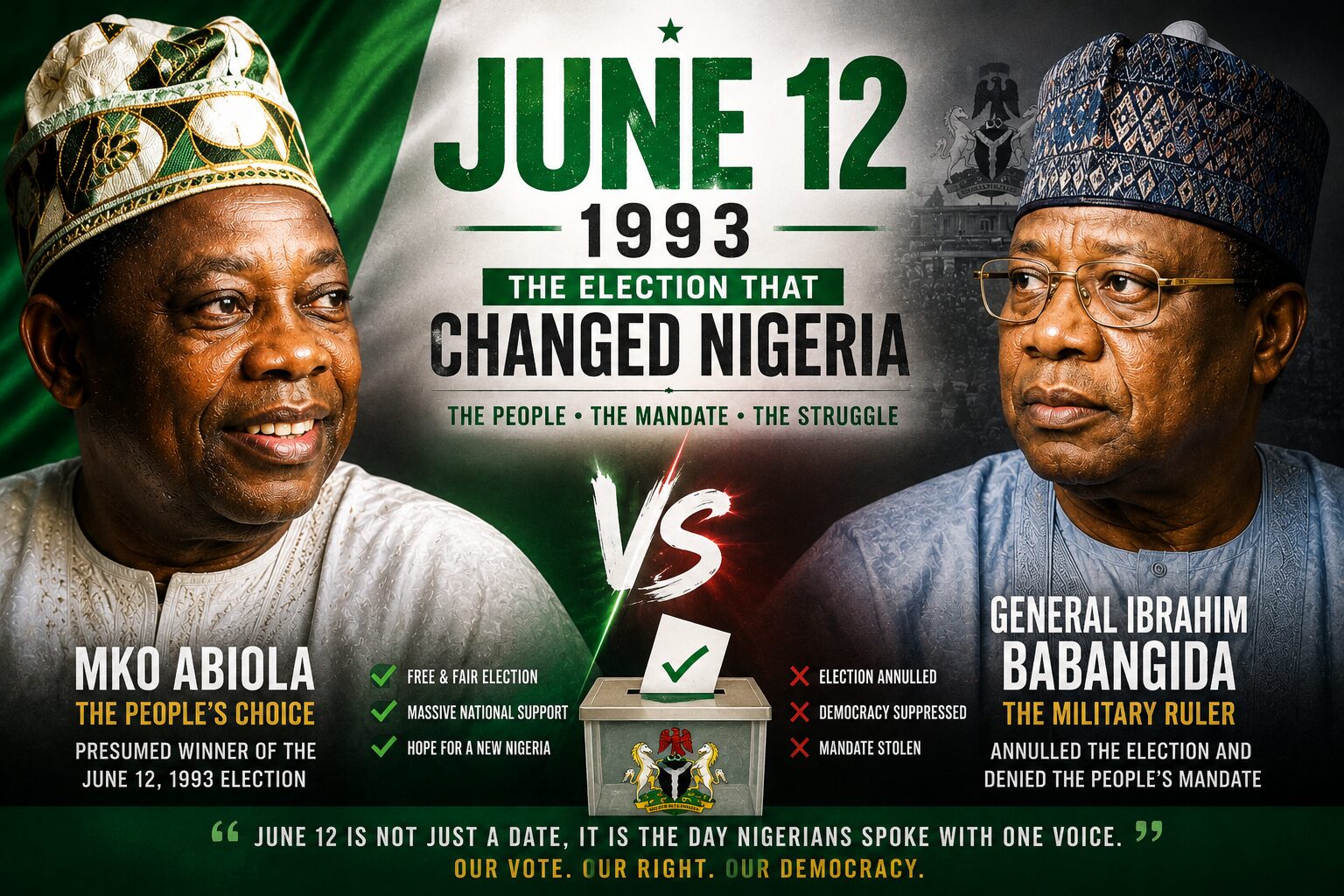
June 12 occupies a special place in Nigeria’s political history. For millions of Nigerians, it represents the struggle for democracy, justice, and the right of citizens to choose their leaders through free and fair elections.
The date commemorates the historic presidential election held on June 12, 1993, which is widely regarded as the freest and fairest election in Nigeria’s history. Although the election was later annulled by the military government, the events that followed transformed June 12 into a powerful symbol of democratic resistance.
Today, June 12 is celebrated annually as Nigeria’s Democracy Day, honoring the sacrifices made by pro-democracy activists and recognizing the legacy of Chief Moshood Kashimawo Olawale (MKO) Abiola.
Nigeria Before June 12
Nigeria spent much of its post-independence history under military rule. Following a series of military coups beginning in 1966, democratic governance was repeatedly interrupted.
By the late 1980s and early 1990s, Nigerians were increasingly demanding a return to civilian rule. Under the military government of General Ibrahim Babangida, a transition program was initiated to hand power back to elected civilians.
As part of the transition process, two political parties were created:
- Social Democratic Party (SDP)
- National Republican Convention (NRC)
The stage was set for what would become one of the most important elections in African history.
The June 12, 1993 Presidential Election
The presidential election took place on June 12, 1993.
The main contenders were:
MKO Abiola (SDP)
Chief MKO Abiola was a wealthy businessman, philanthropist, publisher, and politician from Ogun State.
His campaign focused on:
- Poverty reduction
- National unity
- Economic growth
- Democratic governance
Bashir Tofa (NRC)
Alhaji Bashir Tofa was the candidate of the National Republican Convention and represented the ruling establishment’s preferred alternative.
Why the Election Was Historic
The June 12 election was unique for several reasons.
National Unity
For the first time in Nigerian political history, ethnic and religious divisions appeared less important.
Abiola, a southern Muslim, selected another Muslim, Babagana Kingibe, as his running mate.
Despite concerns over a Muslim-Muslim ticket, Nigerians voted across ethnic and religious lines.
Free and Fair Process
Local and international observers praised the election for being transparent and peaceful.
There were few reports of violence, ballot stuffing, or widespread irregularities.
Many observers continue to describe June 12 as Nigeria’s most credible election.
Broad National Support
Abiola won votes across Nigeria’s regions, including many northern states.
His ability to unite voters from different backgrounds made the election a landmark moment in Nigerian democracy.
The Annulment of the Election
Despite the success of the election, the military government unexpectedly annulled the results before they could be formally completed.
The decision shocked Nigerians.
Protests erupted across the country as citizens demanded that the election results be recognized.
Many Nigerians viewed the annulment as a betrayal of the democratic process and an attack on the will of the people.
The annulment triggered a political crisis that would last for years.
The Rise of the Pro-Democracy Movement
Following the annulment, civil society organizations, labor unions, students, journalists, and political activists launched a nationwide campaign to restore the June 12 mandate.
Major pro-democracy groups emerged, including:
- National Democratic Coalition (NADECO)
- Campaign for Democracy (CD)
- Various human rights organizations
These groups organized protests, strikes, and advocacy campaigns against military rule.
Many activists were arrested, detained, or forced into exile.
MKO Abiola Declares Himself President
On June 11, 1994, one year after the election, MKO Abiola declared himself the rightful President of Nigeria.
The military government led by General Sani Abacha responded swiftly.
Abiola was arrested and charged with treason.
His detention became a symbol of the broader struggle for democracy in Nigeria.
For four years, he remained imprisoned while pro-democracy activists continued to demand his release.
Death of MKO Abiola
On July 7, 1998, MKO Abiola died unexpectedly while still in detention.
His death came only weeks after the sudden death of General Sani Abacha.
The news shocked Nigeria and intensified calls for a return to democratic governance.
Although Abiola never occupied the presidency, many Nigerians regard him as the legitimate winner of the June 12 election.
Return to Democracy
Following the deaths of both Abacha and Abiola in 1998, General Abdulsalami Abubakar initiated a transition program.
Democratic elections were conducted in 1999, leading to the inauguration of President Olusegun Obasanjo on May 29, 1999.
This marked the beginning of Nigeria’s Fourth Republic.
Why June 12 Became Democracy Day
For many years, Nigeria celebrated Democracy Day on May 29, the date civilian rule returned in 1999.
However, many Nigerians argued that June 12 better represented the country’s democratic struggle.
In 2018, President Muhammadu Buhari officially recognized June 12 as Nigeria’s Democracy Day.
The government also posthumously awarded MKO Abiola the Grand Commander of the Federal Republic (GCFR), one of Nigeria’s highest national honors.
This decision acknowledged Abiola’s role in Nigeria’s democratic journey.
Significance of June 12 Today
June 12 serves as a reminder of:
The Power of the People’s Vote
The election demonstrated that Nigerians could unite across ethnic and religious lines to choose their leaders.
The Importance of Democracy
The events surrounding June 12 highlight the value of free and fair elections.
Sacrifice for Freedom
Many individuals risked their lives, careers, and freedom during the struggle for democracy.
National Unity
June 12 remains one of the few moments in Nigerian history when citizens overwhelmingly voted beyond ethnic and religious considerations.
June 12 Timeline
1993
- June 12 presidential election held.
- MKO Abiola emerges as the apparent winner.
1993
- Election annulled by the military government.
1994
- Abiola declares himself president.
- He is arrested and detained.
1998
- General Sani Abacha dies.
- MKO Abiola dies in detention.
1999
- Nigeria returns to democratic rule.
2018
- June 12 officially becomes Democracy Day.
Frequently Asked Questions
What happened on June 12 in Nigeria?
Nigeria held a presidential election on June 12, 1993, widely regarded as the freest and fairest election in the country’s history.
Who won the June 12 election?
MKO Abiola is widely believed to have won the election before it was annulled.
Why was the election annulled?
The military government led by General Ibrahim Babangida annulled the election, leading to a national political crisis.
Why is June 12 important?
June 12 symbolizes democracy, electoral justice, and the struggle against military rule in Nigeria.
When did June 12 become Democracy Day?
June 12 officially became Nigeria’s Democracy Day in 2018.
Conclusion
June 12 remains one of the most significant dates in Nigerian history. It represents the triumph of democratic ideals over authoritarianism and serves as a reminder of the sacrifices made by countless Nigerians in the pursuit of freedom and justice.
More than three decades after the election, June 12 continues to inspire conversations about democracy, accountability, and national unity. The legacy of MKO Abiola and the struggle for the June 12 mandate remain central chapters in Nigeria’s democratic story.