
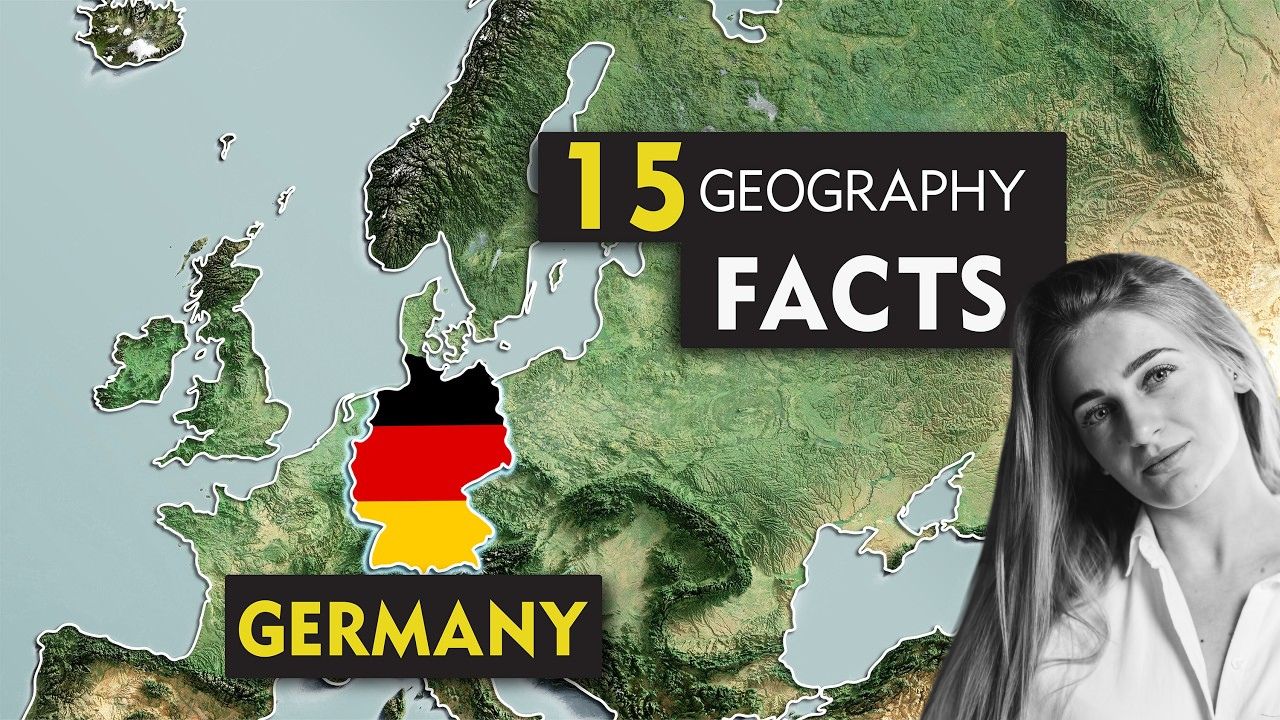
Germany is often seen as a country of innovation, precision, and history—but beneath its structured surface lies a trove of astonishing geography facts that many people don’t know. From glowing cities and narrow streets to volcanic fields and space-diamond towns, Germany’s natural and man-made features are full of surprises.
In this article, we uncover 15 incredible geography facts about Germany that will change the way you see this powerhouse of Europe.
1. Bavaria Is Larger Than Many European Countries
Germany has 16 federal states, but Bavaria stands out—both in size and significance. Covering over 70,000 square kilometers, it is larger than countries like Ireland, Croatia, or Switzerland.
With a population of 13 million, it’s more populous than Greece or Portugal. Bavaria also plays a critical economic role in Germany’s prosperity.
✅ Learn More: More about Bavaria – Britannica
2. Berlin Glows in Two Colors from Space
At night, Berlin glows in two distinct tones: orange in the east and white in the west. This is a remnant of the Cold War, where East Berlin used older sodium-vapor lamps while West Berlin installed halogen and LED lights.
The visual contrast is still visible from space, symbolizing Berlin’s divided past.
3. Germany Has One of the Strangest Borders with Belgium
Along the Belgium-Germany border lies the Vennbahn railway, which led to a complex border situation. After WWI, Belgium retained the railway but Germany kept the surrounding land, creating five German exclaves entirely surrounded by Belgium.
This border is considered one of the most bizarre in the world.
✅ Learn More: Read about Vennbahn Railway on Atlas Obscura
4. Görlitz Is Split Between Germany and Poland
The town of Görlitz, split by the Neisse River, is half German and half Polish (the Polish side is called Zgorzelec). Despite being in two countries, both sides share a common cultural heritage.
Thanks to the Schengen Agreement, crossing between the two is as simple as walking across a bridge.
5. A German Town Lies Inside Switzerland
Büsingen am Hochrhein is a German town that’s entirely surrounded by Switzerland. Politically it’s German, but economically and practically, it operates like a Swiss town—residents use Swiss francs, follow Swiss laws, and have Swiss phone numbers.
6. Germany Has Mountains Made of Trash
Cities like Stuttgart feature man-made hills called Schuttbergs, created from WWII rubble. These “trash mountains” were later covered with soil and trees to become public parks.
What looks like peaceful green space is actually a powerful reminder of war and resilience.
✅ Learn More: History of Schuttbergs
7. The Tallest Church in the World Is in Germany
Ulm Minster is the world’s tallest church, standing at 161.5 meters. Built in the late 1800s, its Gothic spires dominate the skyline. While Barcelona’s Sagrada Familia may eventually surpass it, Ulm Minster remains a monumental landmark.
8. Nördlingen: A Town Built on Diamonds
Nördlingen, a charming Bavarian town, lies in a meteor crater formed 15 million years ago. The impact created shocked quartz and microscopic diamonds.
Buildings constructed from the local rock literally glitter with diamond dust—a geological marvel!
9. Germany Has Over 1,000 Rivers
From the mighty Rhine to the scenic Elbe and Danube, Germany boasts over 1,000 rivers that play key roles in trade, ecology, and tourism.
These waterways contribute not just to Germany’s economy but also its natural beauty and biodiversity.
10. Funtensee Is Colder Than Siberia
In 2001, Lake Funtensee in the Bavarian Alps recorded a temperature of –45.9°C, colder than many places in Siberia.
Its bowl-like terrain traps cold air, turning it into a natural deep freezer.
11. Bavaria Also Has Germany’s Hottest Temperatures
Surprisingly, Bavaria also records some of Germany’s hottest temperatures. In towns like Kitzingen, summer heatwaves can reach over 40°C.
The temperature swing between Bavaria’s coldest and hottest recorded extremes is 86.2°C—one of the most dramatic in Europe.
12. Germany Has a Volcanically Active Region
Germany’s Eifel Volcanic Field, located in the west, still shows signs of activity. While it hasn’t erupted in millennia, scientists have recorded gas emissions and underground magma movement.
The region features crater lakes and lava domes, making it a hotspot for geologists and tourists.
✅Learn More: Learn more on VolcanoDiscovery
13. Berlin Is the Third Largest Capital in Europe
With 3.9 million residents, Berlin ranks as the third-largest capital city in Europe, behind Moscow and London. It also spans 890 square kilometers, making it eight times bigger than Paris.
It’s a capital of extremes: rich in culture, green spaces, and modern innovation.
14. The World’s Narrowest Street Is in Reutlingen
In Reutlingen, you’ll find Spreuerhofstraße, the narrowest street on Earth, measuring just 31 cm wide at its tightest point.
This quirky alley, built in the 18th century, is now a major tourist attraction and a symbol of old-world German architecture.
15. Germany’s Lowest Point Is Man-Made
The Hambach open-pit coal mine in North Rhine-Westphalia is Germany’s lowest point, reaching 293 meters below sea level.
It’s an industrial giant and a controversial symbol in Germany’s energy and environmental debates.
✅ Learn More: Hambach Mine on Climate News
Final Thoughts
Germany is much more than castles, beer, and autobahns. It’s a country full of strange borders, volcanic activity, record-breaking architecture, and natural phenomena. Whether you’re a geography geek or a curious traveler, these facts reveal a side of Germany you probably never imagined.
Explore More Geography Wonders
If you found this fascinating, check out our other global geography insights:
👉 Top 15 Mind-Blowing Facts About Germany: Europe’s Most Unusual Country