
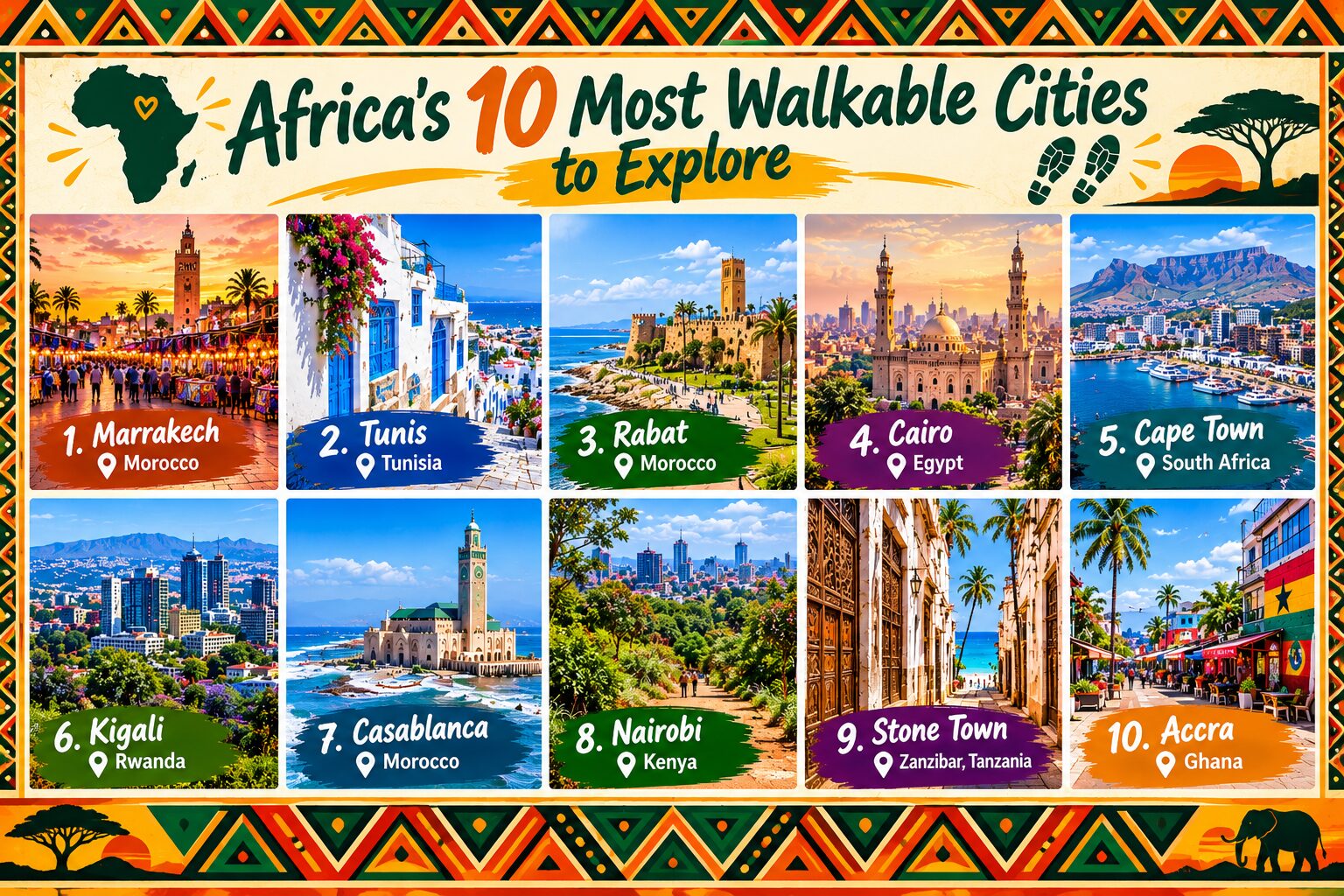
Africa’s cities offer a fascinating mix of historic streets, lively markets, coastal promenades and modern neighbourhoods that can be explored on foot.
From the winding lanes of Marrakech’s medina to the waterfront paths of Cape Town, walking offers visitors a closer look at the continent’s culture, architecture, food and everyday life.
But what makes a city walkable? It is not simply the distance between attractions. Safe pedestrian crossings, continuous pavements, accessible public transport, nearby shops and comfortable public spaces all influence
how easily people can move around without a car.
There is no single, universally accepted ranking of Africa’s most walkable cities. Instead, this guide explores 10 African cities with notable pedestrian-friendly districts, historic centres or walking routes. The selection is editorial rather than an official continent-wide ranking.
What Makes a City Walkable?
A walkable city allows residents and visitors to reach everyday destinations comfortably and safely. These may include shops, workplaces, restaurants, public transport, parks and cultural attractions.
Several factors determine how walkable an area is:
– Accessibility: Are everyday destinations within a reasonable walking distance?
>- Pedestrian infrastructure: Are pavements, crossings and footpaths available and maintained?
>- Safety: Can pedestrians navigate roads without excessive traffic risks?
>- Public transport: Can walking be combined with buses, trams and other transport services?
>- Comfort: Are there shaded routes, seating, green spaces and protection from extreme weather?
>- Connectivity: Can people move between neighbourhoods without unnecessary detours?
These factors are particularly important in rapidly growing African cities. An OECD study of Accra and Kumasi in Ghana found that urban expansion and limited investment in transport infrastructure can leave some residents far from essential services and make journeys on foot more difficult.
10 African Cities Worth Exploring on Foot
1. Marrakech, Morocco
Marrakech is one of North Africa’s most distinctive destinations for exploring on foot. Its historic medina features narrow lanes, traditional markets, courtyards and architectural landmarks that bring visitors close to the city’s cultural life.
Around Jemaa el-Fnaa, the famous central square, visitors can explore food stalls, markets and surrounding streets while experiencing the atmosphere of the old city. Many attractions within the medina are close enough to combine into a walking itinerary.
However, walking here requires attention. Motorbikes, bicycles, delivery traffic and crowds can make some lanes challenging, particularly during busy periods. Visitors should wear comfortable footwear, account for the heat and check routes before setting out.
Best for: Historic streets, traditional markets, cultural attractions and guided walking tours.

2. Tunis, Tunisia
Tunis combines historic charm with modern urban life. Its old medina contains traditional souks, mosques, historic buildings and small businesses arranged along a network of narrow streets.
Walking is an effective way to appreciate the medina’s architecture and discover local shops and food spots that might be missed when travelling by car. Central districts also offer opportunities to combine walking with public transport.
As in many historic centres, some streets are narrow, surfaces may be uneven and crowds can affect movement. Exploring during cooler hours can make a visit more comfortable.
Best for: History, traditional markets, architecture and cultural exploration.
3. Rabat, Morocco
Morocco’s capital offers a combination of historic attractions, public spaces and modern transport connections. Areas around the medina and central districts provide opportunities to explore shops, cafés and landmarks on foot.
Rabat’s tram network also makes it possible to combine walking with longer journeys, reducing the need to depend entirely on private vehicles.
The city’s coastal setting adds another dimension to exploring on foot, although conditions vary between districts. Visitors should consider pavement quality, traffic levels and distances when planning a route.
Best for: Historic sightseeing, urban transport and coastal walks.
4. Cairo, Egypt
Cairo’s dense urban environment places shops, cafés, markets and cultural landmarks close together in many central districts. Downtown Cairo, with its historic architecture and busy commercial streets, offers plenty to discover on foot.
Walking can be rewarding for visitors interested in street life, architecture and local businesses. However, Cairo is also known for heavy traffic, crowded streets and challenging road crossings in some areas.
Pedestrian conditions differ considerably between neighbourhoods. Visitors should use appropriate crossings, remain alert around traffic and consider guided walking tours when exploring unfamiliar areas.
Best for: Urban history, architecture, markets and cultural experiences.
5. Cape Town, South Africa
Cape Town offers some of Africa’s most appealing walking environments, particularly along the Sea Point Promenade and in selected parts of the city centre.
The promenade provides an attractive route beside the Atlantic coastline, with ocean views and space for walking, jogging and enjoying the outdoors. In central areas, visitors can explore restaurants, public spaces, cultural attractions and historic streets on foot.
Nevertheless, Cape Town’s wider metropolitan area includes suburbs where distances are considerable and car travel is often necessary. Safety and route choice also matter, particularly when walking after dark or in unfamiliar areas.
Best for: Coastal promenades, outdoor recreation and selected central neighbourhoods.
6. Kigali, Rwanda
Kigali is known for its hilly landscape, growing urban infrastructure and neighbourhoods that offer opportunities to explore local businesses on foot aside from fascinating areas like the famous Nyungwe National Park.
Some central areas provide access to restaurants, shops and services within relatively short distances. Walking can also give visitors a closer view of everyday life in Rwanda’s capital.
However, the city’s hills can make longer journeys physically demanding. Pedestrian facilities and road conditions vary by location, so a route that looks short on a map may require more effort than
expected.
Visitors should consider the terrain, weather and distance between destinations when planning their walks.
Best for: Neighbourhood exploration, local food and short urban walks.
7. Casablanca, Morocco
Casablanca is a major commercial centre with dense districts, shopping streets and a modern tram network. In selected central areas, visitors can combine walking with public transport to reach restaurants, businesses and cultural landmarks.
Its urban character differs from the historic atmosphere of Marrakech. Casablanca is a larger, busier city where walkability depends heavily on the neighbourhood and the route chosen. The City accomodates one of the best Beach Resorts in Morocco for Your Vacation Stay, Four Seasons Hotel Casablanca.
Some areas are convenient for short trips on foot, while others involve major roads, longer distances or less comfortable pedestrian conditions. Planning a route that connects nearby destinations can make exploration more practical.
Best for: Commercial districts, architecture, city life and public-transport connections.
8. Nairobi, Kenya
Nairobi offers lively neighbourhoods where restaurants, cafés, shops and entertainment venues are clustered within walking distance. It is also home to Top Safari Parks You Can’t Miss.
Areas such as parts of Westlands and other established commercial districts can be convenient for exploring several destinations in one outing.
The city’s appeal lies partly in its mix of modern businesses, local markets and cultural attractions. Walking between nearby venues can offer a different perspective from travelling everywhere by vehicle.
However, Nairobi’s pedestrian environment is inconsistent. Pavement continuity, road crossings, traffic and personal security all need consideration. Visitors should choose routes carefully and seek local advice when exploring unfamiliar areas.
Best for: Neighbourhood dining, shopping and selected commercial districts.
9. Stone Town, Zanzibar, Tanzania
Stone Town stands out as a compact historic district rather than a large metropolitan city. Its narrow lanes, traditional buildings, markets and cultural landmarks make it especially rewarding to explore on foot.
Visitors can wander through historic streets, discover local shops and experience the distinctive architecture shaped by centuries of cultural exchange across the Indian Ocean.
Because many lanes are narrow and winding, walking is often more practical than attempting to navigate the historic centre by car. However, pedestrians should remain aware of bicycles, motorbikes and other local traffic.
Stone Town’s scale makes it possible to build a relaxed itinerary around nearby attractions, with breaks for local
food and waterfront views.
Best for: Heritage tourism, architecture, markets and cultural walking tours.
10. Accra, Ghana
Accra has lively neighbourhoods, busy commercial streets and areas where restaurants, shops and entertainment venues are close together. Osu, for example, is known for its concentration of dining and leisure options.
These clusters can make short local journeys convenient on foot. However, nearby destinations do not automatically mean the routes between them are comfortable or safe.
Research published in the journal Cities in 2025 examined pedestrian experiences in Accra New Town.
It found that residents adapt their surroundings to address gaps in pedestrian infrastructure, including drainage, lighting and shade. The findings highlight the importance of safety and better pedestrian-focused planning.
Best for: Local food, nightlife and exploring selected neighbourhoods.
Why Walkability Matters for African Cities
Walkable neighbourhoods can make daily life more convenient by connecting people with workplaces, shops, public transport and community facilities. They can also support physical activity, encourage local businesses and create more opportunities for social interaction.
As Africa’s urban population grows, planning cities around people as well as vehicles will become increasingly important. The OECD and its partner organisations projected in Africa’s Urbanisation Dynamics 2025 report that the continent’s urban population could grow from approximately 700 million in 2020 to 1.4 billion by 2050.
This growth creates both challenges and opportunities. Without thoughtful planning, expanding cities can leave homes, workplaces and essential services far apart. With better planning, urban areas can become more accessible, connected and inclusive.
Improving walkability requires more than attractive pedestrian streets. Cities need connected pavements, safe crossings, accessible routes for people with disabilities, better lighting, drainage, shade and reliable links to public transport.
These improvements can help residents of different ages and abilities navigate their communities more comfortably.
Frequently Asked Questions
Which African city is the most walkable?
No universally accepted continent-wide ranking names one African city as the most walkable. Marrakech, Tunis, Rabat and Cape Town each have notable areas for walking, but conditions vary by neighbourhoods.
Which African city is best for walking tours?
Marrakech, Tunis and Stone Town are particularly appealing for historic walking tours because of their compact heritage districts, traditional markets and cultural landmarks. Always consider Local conditions and route safety.
Is Cape Town a walkable city?
Some parts of Cape Town, including the Sea Point Promenade and selected central neighbourhoods, are well suited to walking. However, the wider metropolitan area is spread out, and many journeys still require transport.
What makes African cities difficult to walk around?
Common challenges include incomplete pavements, unsafe crossings, heavy traffic, poor drainage, heat and long distances between destinations. But then conditions vary significantly between cities and neighbourhoods.
Why is urban walkability important?
Walkability helps people access essential services, supports active lifestyles, connects communities and can benefit local businesses. Also, safe, accessible pedestrian infrastructure is especially important for children, older people and people with disabilities.
Final Thoughts
Africa’s most walkable urban experiences are diverse. From Marrakech’s historic medina and Stone Town’s winding lanes to Cape Town’s coastal promenade and the lively districts of Accra and Nairobi, the continent offers many ways to discover city life on foot.
However, no city should be judged solely by its most attractive walking district. True walkability means residents can travel safely and comfortably through everyday neighbourhoods, reach essential services and connect with public transport.
Also, as African cities continue to grow, better pedestrian infrastructure and more inclusive urban planning could help make walking a more enjoyable choice for residents and visitors alike.
Progressively, which African city would you most like to explore on foot? Share your thoughts and tell us about your favourite walkable neighbourhood.