
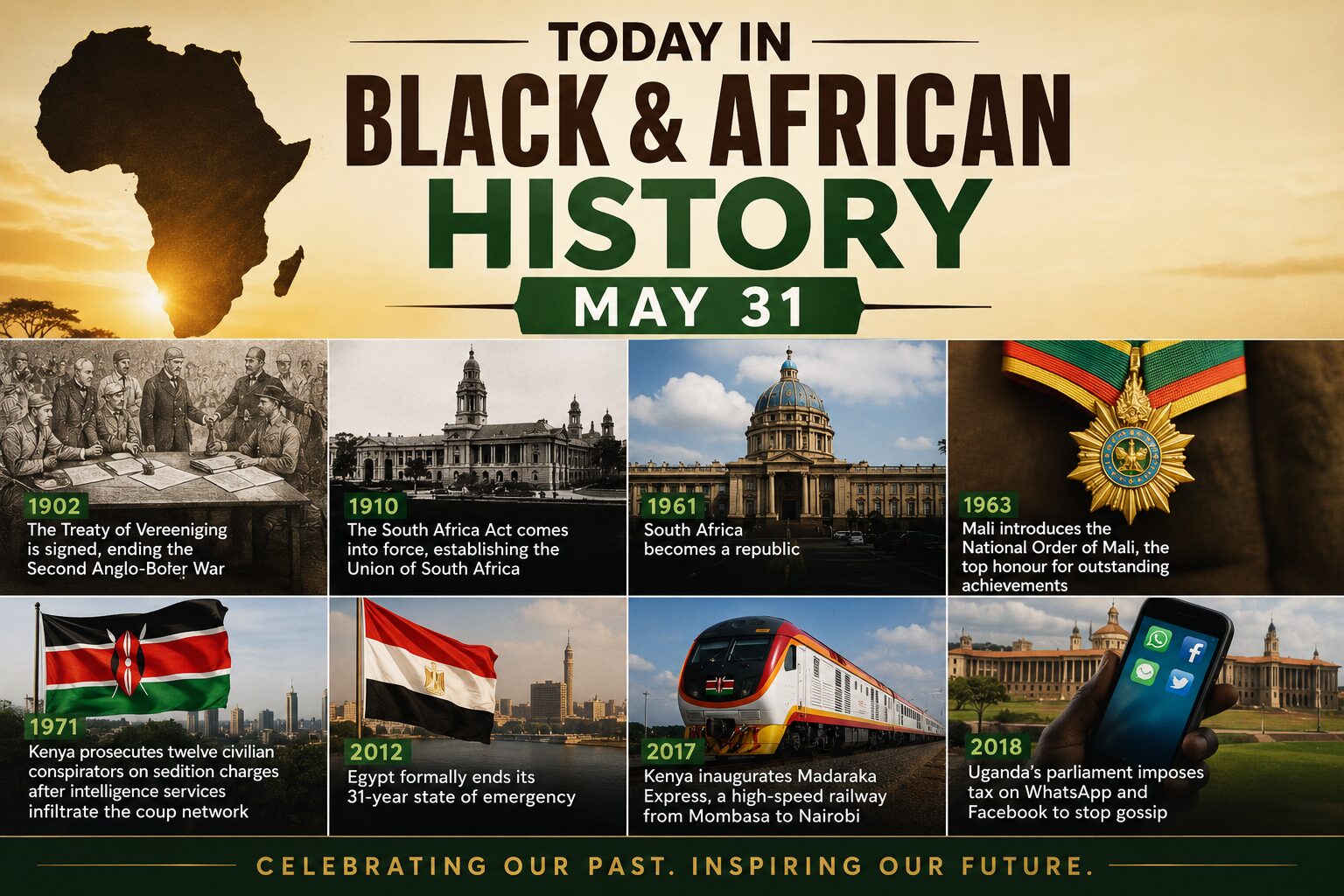
From the end of a devastating war in South Africa to the launch of East Africa’s largest railway project, May 31 marks several important moments in African history. The day has witnessed political transitions, infrastructure milestones, legal reforms, and decisions that shaped the lives of millions across the continent.
Here are some of the most significant events that happened on May 31 in Black and African history.
1902: The Treaty of Vereeniging Ends the Second Anglo-Boer War
On May 31, 1902, the Treaty of Vereeniging was signed, bringing an end to the Second Anglo-Boer War between the British Empire and the Boer republics in South Africa.
The war, which began in 1899, was one of the deadliest conflicts in Southern African history. It resulted in tens of thousands of deaths and widespread destruction across the region.
Under the treaty, the Boer republics agreed to British sovereignty in exchange for promises of reconstruction and eventual self-government.
The agreement laid the foundation for the political developments that would eventually lead to the formation of the Union of South Africa.
Related Reading
→ History of the Anglo-Boer Wars
1910: The Union of South Africa Is Established
Eight years after the end of the Anglo-Boer War, the South Africa Act officially came into force on May 31, 1910.
The legislation united the Cape Colony, Natal, Transvaal, and Orange River Colony into a single political entity known as the Union of South Africa.
Although the union represented a major political milestone, it largely excluded Black South Africans from meaningful participation in government and laid the groundwork for decades of racial segregation.
The Union of South Africa remained part of the British Empire while enjoying significant self-government.
Related Reading
→ How the Union of South Africa Was Formed
→ Timeline of South African History
1961: South Africa Becomes a Republic
On May 31, 1961, South Africa officially became a republic after a referendum among white voters approved the country’s departure from the British Commonwealth.
The move marked the end of the monarchy’s constitutional role in South Africa and the beginning of the Republic of South Africa.
However, the change occurred during the height of apartheid, the system of racial segregation that denied political and civil rights to the country’s Black majority.
South Africa would remain outside the Commonwealth until 1994, when the election of Nelson Mandela marked the end of apartheid.
Related Reading
→ The History of Apartheid in South Africa
→ How Nelson Mandela Changed South Africa
1963: Mali Creates the National Order of Mali
On May 31, 1963, Mali introduced the National Order of Mali, the country’s highest national honour.
The award recognizes individuals who have made outstanding contributions to the nation through public service, culture, education, science, diplomacy, or national development.
Since its creation, the honour has been awarded to distinguished Malians and international figures whose achievements have positively impacted the country.
Related Reading
→ National Honours and Awards Across Africa
1971: Kenya Foils a Coup Plot
On May 31, 1971, the Kenyan government prosecuted twelve civilians on sedition charges after security services infiltrated and disrupted an alleged coup network.
The conspiracy was reportedly aimed at overthrowing the government of President Jomo Kenyatta.
The incident highlighted political tensions within Kenya during the early post-independence era and demonstrated the government’s determination to maintain stability following independence from Britain.
The failed plot remains one of the lesser-known episodes in Kenyan political history.
Related Reading
→ The 1971 Kenyan Coup Plot Explained
→ Major Coup Attempts in African History
2012: Egypt Ends Its 31-Year State of Emergency
A major political milestone occurred on May 31, 2012, when Egypt formally ended the state of emergency that had been in place since 1981.
The emergency law had granted authorities broad powers, including restrictions on public gatherings, expanded police authority, and limitations on civil liberties.
Its removal came in the aftermath of the Arab Spring protests that led to the resignation of President Hosni Mubarak in 2011.
Many Egyptians viewed the decision as a significant step toward democratic reform and greater political freedoms.
Related Reading
→ The Arab Spring and Its Impact on Africa
→ Egypt’s Political Transformation After 2011
2017: Kenya Launches the Madaraka Express
On May 31, 2017, Kenya inaugurated the Madaraka Express, a modern standard-gauge railway connecting the port city of Mombasa to the capital, Nairobi.
The railway became Kenya’s largest infrastructure project since independence and significantly reduced travel time between the two cities.
The project was designed to improve trade, boost economic development, and strengthen transportation networks across East Africa.
Today, the Madaraka Express remains one of the most important transportation projects in the region.
Related Reading
→ Africa’s Largest Infrastructure Projects
→ How Railways Are Transforming Africa
2018: Uganda Introduces Social Media Tax
On May 31, 2018, Uganda’s parliament approved a controversial tax on social media usage, targeting platforms such as Facebook, WhatsApp, and Twitter.
The government argued that the measure would generate revenue and reduce what officials described as excessive online gossip.
The decision sparked widespread criticism from civil society groups, technology advocates, and young people, who argued that it limited digital access and freedom of expression.
The tax attracted international attention and became one of Africa’s most debated internet policies.
Related Reading
→ Internet Freedom in Africa
→ The Rise of Social Media Across Africa
Timeline: May 31 in Black & African History
- 1902 – Treaty of Vereeniging ends the Second Anglo-Boer War.
- 1910 – Union of South Africa is established.
- 1961 – South Africa officially becomes a republic.
- 1963 – Mali creates the National Order of Mali.
- 1971 – Kenya prosecutes conspirators involved in a failed coup plot.
- 2012 – Egypt ends its 31-year state of emergency.
- 2017 – Kenya launches the Madaraka Express railway.
- 2018 – Uganda approves a social media tax.
Why May 31 Matters
May 31 highlights the diverse political, economic, and social developments that have shaped Africa over the last century. From the end of colonial-era conflicts and the formation of modern states to infrastructure development and debates over digital freedoms, the events of this day reflect Africa’s ongoing journey of transformation and progress.
What Do You Think?
Which of these events had the greatest impact on African history? Share your thoughts in the comments below.