Today in Black & African History: May 29 — Sojourner Truth, Obasanjo & Tom Bradley

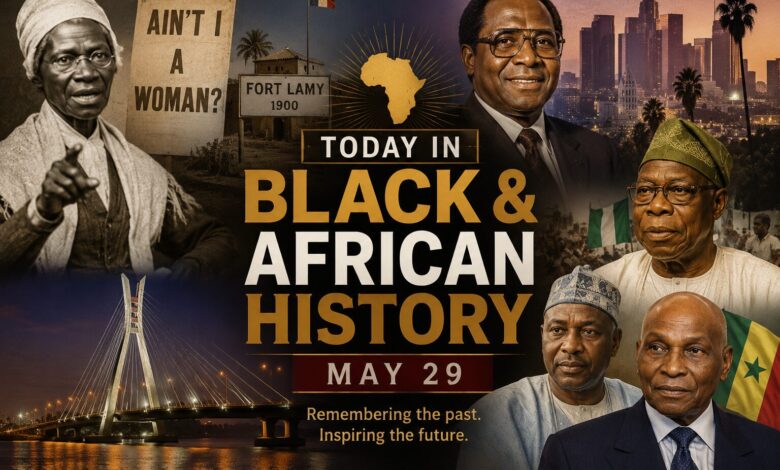
From historic speeches and political breakthroughs to the founding of African capitals and landmark infrastructure projects, May 29 has witnessed several important moments in Black and African history. Here are some of the most notable events that happened on this day.
On This Day in Black & African History — May 29
History is shaped by individuals and events that challenge injustice, transform nations, and inspire future generations. May 29 is one such day, marked by milestones in civil rights, democracy, African politics, and urban development.
Among the most significant events are Sojourner Truth’s legendary speech on women’s rights, Nigeria’s return to civilian rule under Olusegun Obasanjo, the election of Los Angeles’ first Black mayor, and the commissioning of the iconic Lekki-Ikoyi Link Bridge.
1851: Sojourner Truth Delivers the “Ain’t I a Woman?” Speech
On May 29, 1851, abolitionist and women’s rights advocate Sojourner Truth delivered her famous speech at the Women’s Rights Convention in Akron, Ohio.
Born into slavery, Truth became one of the most influential voices in the fight against slavery and gender discrimination. Her speech challenged the idea that women were weak and incapable while highlighting the double discrimination faced by Black women in America.
More than 170 years later, the speech remains one of the most powerful statements on equality and justice ever delivered.
Related Reading:
→ The Story Behind Sojourner Truth’s “Ain’t I a Woman?” Speech
Source: National Women’s History Museum
1900: N’Djamena Is Founded as Fort Lamy
On this day in 1900, French colonial forces established Fort Lamy, the settlement that would later become N’Djamena, the capital of Chad.
Strategically located along the Chari River, the city developed into an important administrative and commercial center in Central Africa. Following independence, Chad renamed the city N’Djamena in 1973.
Today, it serves as the political, economic, and cultural heart of the country.
1973: Tom Bradley Becomes Los Angeles’ First Black Mayor
May 29, 1973, marked a major breakthrough in American politics when Tom Bradley was elected mayor of Los Angeles.
Bradley became the first Black mayor of the city and one of the most influential African American political leaders of the twentieth century. His election represented a significant victory against racial barriers that had long existed in American public office.
During his five terms as mayor, Bradley helped modernize Los Angeles and oversaw preparations for the successful 1984 Olympic Games.
Related Reading:
→ Tom Bradley: The First Black Mayor of Los Angeles
Source: Los Angeles Public Library
1999: Olusegun Obasanjo Is Sworn In as President of Nigeria
One of the most important dates in modern Nigerian history occurred on May 29, 1999.
Former military leader Olusegun Obasanjo was sworn in as Nigeria’s president, ending more than 16 years of military rule and ushering in the Fourth Republic.
His inauguration symbolized the restoration of democracy in Africa’s most populous country and remains a defining moment in Nigeria’s political journey.
Today, Democracy Day is celebrated in recognition of Nigeria’s democratic struggle, although the official date was later moved to June 12.
Related Reading:
→ How Olusegun Obasanjo Helped Restore Civilian Rule in Nigeria
Source: Nigeria’s National Archives
2002: Alpha Oumar Konaré Pardons Moussa Traoré
On May 29, 2002, Malian President Alpha Oumar Konaré granted a pardon to former military ruler Moussa Traoré and his wife.
The move was widely viewed as an effort to promote national reconciliation following years of political tension after Traoré’s overthrow in 1991.
The pardon represented an important chapter in Mali’s democratic development and efforts to heal divisions from the past.
2007: Umaru Musa Yar’Adua Becomes President of Nigeria
Nigeria witnessed another democratic transition on May 29, 2007, when Umaru Musa Yar’Adua took office as president.
Yar’Adua became known for promoting the rule of law, transparency, and reforms aimed at improving governance. Although his presidency was shortened by illness, many Nigerians continue to regard him as one of the country’s most respected leaders.
His administration also launched the Niger Delta Amnesty Programme, which sought to reduce unrest in the oil-producing region.
Related Reading:
→ Umaru Yar’Adua’s Legacy in Nigerian Politics
2013: Nigeria Commissions the Lekki-Ikoyi Link Bridge
On May 29, 2013, Nigeria officially commissioned the Lekki-Ikoyi Link Bridge in Lagos.
The bridge became Nigeria’s first cable-stayed bridge and quickly emerged as one of the country’s most recognizable landmarks. It improved transportation between Lekki and Ikoyi while symbolizing Lagos’ rapid urban development.
Today, the bridge remains a major tourist attraction and one of the most photographed locations in Nigeria.
Related Reading:
→ History of the Lekki-Ikoyi Link Bridge
Born on This Day: Abdoulaye Wade (1926)
Former Senegalese president Abdoulaye Wade was born on May 29, 1926.
Wade played a crucial role in Senegal’s democratic evolution and became president in 2000 after defeating long-serving incumbent Abdou Diouf. His victory marked the first peaceful transfer of power between political parties in Senegal’s history.
His administration oversaw major infrastructure projects and strengthened Senegal’s role in regional politics.
Timeline: May 29 in Black & African History
- 1851 – Sojourner Truth delivers the “Ain’t I a Woman?” speech.
- 1900 – Fort Lamy (modern-day N’Djamena) is founded.
- 1973 – Tom Bradley becomes the first Black mayor of Los Angeles.
- 1999 – Olusegun Obasanjo is sworn in as Nigeria’s president.
- 2002 – Alpha Oumar Konaré pardons Moussa Traoré.
- 2007 – Umaru Musa Yar’Adua becomes president of Nigeria.
- 2013 – Nigeria commissions the Lekki-Ikoyi Link Bridge.
- 1926 – Abdoulaye Wade is born in Senegal.
Why May 29 Matters
The events of May 29 highlight recurring themes throughout Black and African history: the struggle for equality, the fight for democracy, political transformation, and national development.
From Sojourner Truth’s call for justice to Nigeria’s democratic rebirth and the rise of influential African leaders, this day serves as a reminder of the people and moments that helped shape the modern world.
What Do You Think?
Of all the events that happened on May 29, which do you believe had the greatest impact on Black or African history? Share your thoughts in the comments below.