



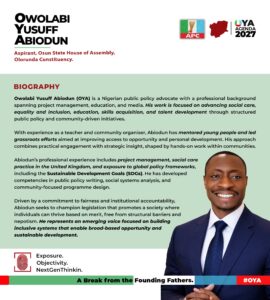
In every thriving democracy, meaningful change begins at the grassroots. For Olorunda Constituency in Osun State, the call for responsive, accountable, and people-centered representation has grown louder over the years. It is within this context that Owolabi Yusuff Abiodun emerges—not just as an aspirant, but as a voice shaped by lived experience, global exposure, and a clear vision for community development.
Raised in Ota-Efun and deeply rooted in the realities of Olorunda, Abiodun understands firsthand the challenges facing the constituency. His journey—from local beginnings to pursuing a Master’s degree in the United Kingdom—has broadened his perspective while strengthening his commitment to home. It is this blend of local insight and global awareness that informs his approach to leadership.
Central to his agenda is improving the quality of life for all. This vision is anchored on practical priorities—support for youth development, strengthening small and medium-scale enterprises (SMEs), expanding access to quality education, and protecting the welfare of the elderly and vulnerable.
Youth empowerment, in particular, stands out as a cornerstone of his plans. With many young people facing unemployment or lacking direction, Abiodun emphasizes the need for structured opportunities that go beyond rhetoric. From skills acquisition programs to talent development initiatives, his focus is on equipping young people with tools for sustainable growth and connecting them to broader opportunities.
Equally important is his commitment to education—not just as a system, but as a transformative force. He advocates for improved learning environments, the revival of community libraries, and the integration of practical skills into educational pathways. By promoting both academic and vocational development, he seeks to create inclusive opportunities for success.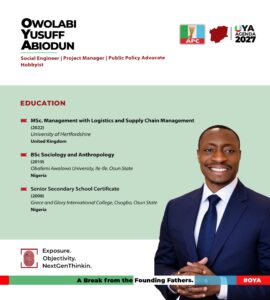
Abiodun also places strong emphasis on social responsibility. A society, he argues, is only as strong as how it treats its most vulnerable members. His pledge to support widows, widowers, senior citizens, and disadvantaged groups reflects a broader vision of governance rooted in dignity and compassion.
Beyond policies, however, lies the issue of accountability. Abiodun’s message resonates with a growing demand for transparency in governance. His commitment to ensuring that resources allocated to Olorunda are properly utilized addresses a long-standing concern among constituents. It is a promise that speaks not just to governance, but to trust.
His call for alignment with broader state and national leadership further highlights a pragmatic approach to development—recognizing that progress often requires collaboration across all levels of government.
Ultimately, the 2027 Osun State House of Assembly election presents more than a routine political exercise for Olorunda. It is an opportunity to redefine representation—moving from passive occupancy to active engagement, from promises to measurable outcomes.
As conversations around leadership continue, one thing remains clear: the future of Olorunda will depend on voices willing to speak, act, and deliver. Whether Owolabi Yusuff Abiodun becomes that voice will be decided at the polls, but his message has already contributed to a broader and necessary dialogue—one centered on accountability, opportunity, and a better quality of life for all.