
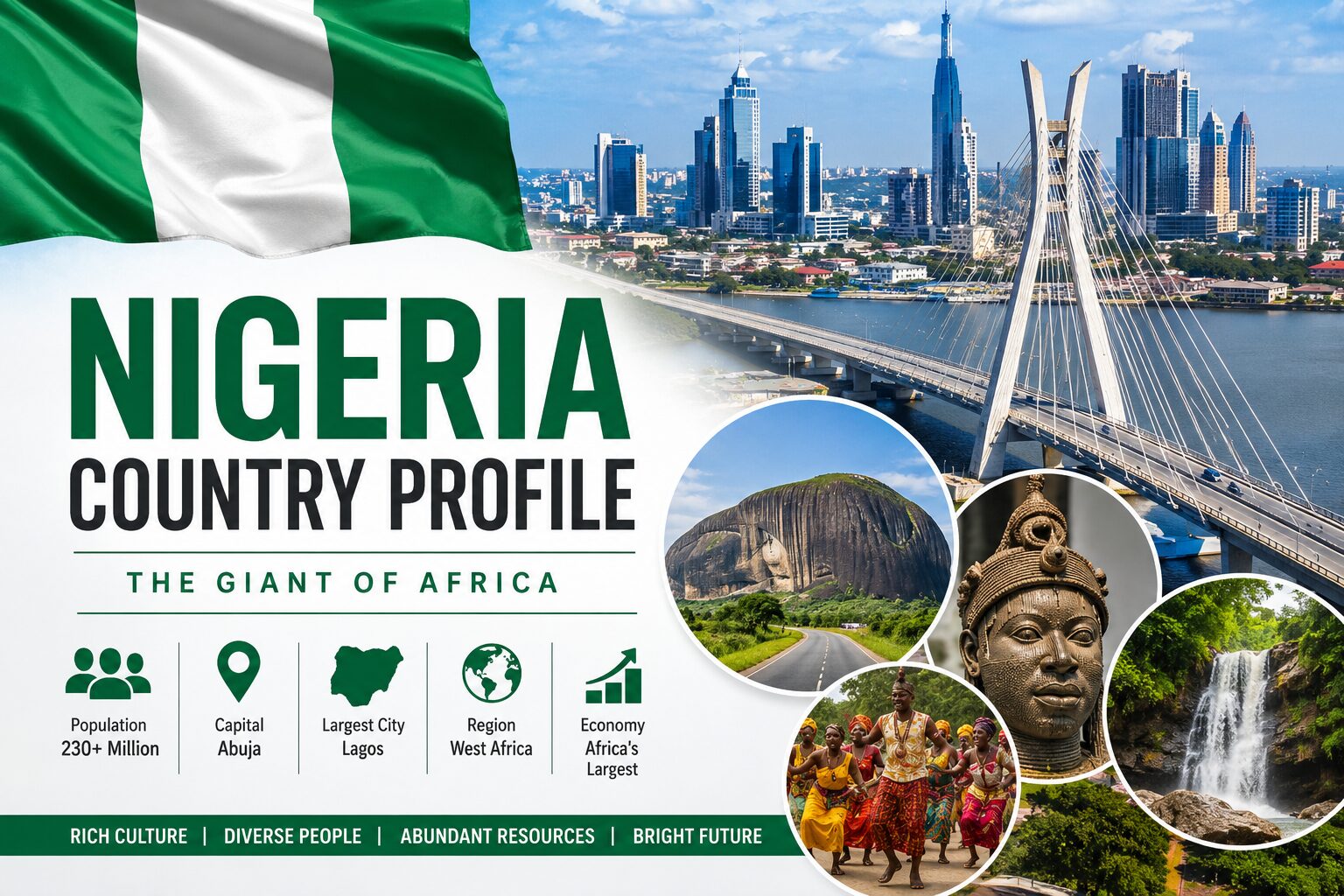
Nigeria, officially known as the Federal Republic of Nigeria, is the most populous country in Africa and one of the continent’s largest economies. Located in West Africa, Nigeria is often referred to as the “Giant of Africa” due to its large population, economic influence, cultural impact, and leadership role in regional affairs.
The country is renowned for its diverse ethnic groups, rich cultural heritage, abundant natural resources, thriving entertainment industry, and strategic importance within Africa and the global community.
Quick Facts About Nigeria
| Category | Information |
|---|---|
| Official Name | Federal Republic of Nigeria |
| Capital City | Abuja |
| Largest City | Lagos |
| Population | Over 230 million |
| Area | 923,768 km² |
| Official Language | English |
| Currency | Nigerian Naira (NGN) |
| Independence | October 1, 1960 |
| Government | Federal Presidential Republic |
| President | Bola Ahmed Tinubu |
| Time Zone | West Africa Time (WAT, UTC+1) |
| Calling Code | +234 |
| Internet Domain | .ng |
Location and Geography
Nigeria is located on the western coast of Africa along the Gulf of Guinea. It shares borders with:
- Benin to the west
- Niger to the north
- Chad to the northeast
- Cameroon to the east
- Atlantic Ocean to the south
The country’s landscape ranges from coastal mangrove swamps and rainforests in the south to savannah grasslands and semi-arid regions in the north.
Major geographical features include:
- Niger River
- Benue River
- Jos Plateau
- Mambilla Plateau
- Chad Basin
- Niger Delta
The Niger Delta is one of the world’s largest river deltas and contains significant oil reserves.
History of Nigeria
Human settlements in Nigeria date back thousands of years.
Ancient Kingdoms and Empires
Before colonial rule, Nigeria was home to several powerful civilizations, including:
- Nok Civilization (c. 1000 BC–300 AD)
- Kanem-Bornu Empire
- Oyo Empire
- Benin Kingdom
- Hausa City States
- Sokoto Caliphate
These societies developed advanced political systems, trade networks, and artistic traditions.
Colonial Era
Britain gradually expanded control over the region during the 19th century.
In 1914, the Northern and Southern Protectorates were amalgamated to form modern Nigeria under British administration.
Independence
Nigeria gained independence from the United Kingdom on October 1, 1960.
The country became a republic in 1963.
Civil War
Between 1967 and 1970, Nigeria experienced the Nigerian Civil War, also known as the Biafran War, following the attempted secession of the Eastern Region.
Democratic Era
After decades of military rule and political transitions, Nigeria returned to democratic governance in 1999 and has maintained civilian rule since then.
Population and Ethnic Groups
Nigeria has the largest population in Africa and is among the most populous countries in the world.
The country is highly diverse, with over 250 ethnic groups.
The largest ethnic groups include:
- Hausa-Fulani
- Yoruba
- Igbo
- Ijaw
- Kanuri
- Tiv
- Ibibio
- Edo
- Nupe
This diversity contributes significantly to Nigeria’s cultural richness.
Languages
English serves as the official language and is used in government, education, and business.
Widely spoken indigenous languages include:
- Hausa
- Yoruba
- Igbo
- Fulfulde
- Kanuri
- Tiv
- Edo
- Ibibio
Nigeria is estimated to have over 500 languages.
Religion
Nigeria is religiously diverse.
Major religions include:
- Islam
- Christianity
- African Traditional Religions
Islam predominates in much of the north, while Christianity is more prevalent in the south. Traditional beliefs continue to influence cultural practices throughout the country.
Government and Politics
Nigeria operates a federal presidential system consisting of:
- Executive Branch
- Legislative Branch
- Judicial Branch
The country is divided into:
- 36 states
- Federal Capital Territory (Abuja)
- 774 local government areas
The President serves as both Head of State and Head of Government.
Economy
Nigeria possesses one of Africa’s largest economies.
Major sectors include:
Petroleum
Nigeria is one of Africa’s leading oil producers and exporters. Oil revenues remain a significant source of government income.
Agriculture
Major agricultural products include:
- Cassava
- Yam
- Cocoa
- Rice
- Maize
- Palm Oil
- Sorghum
Telecommunications
Nigeria hosts one of Africa’s fastest-growing digital economies.
Manufacturing
Industries include:
- Cement
- Food Processing
- Textiles
- Chemicals
- Consumer Goods
Financial Services
Lagos serves as West Africa’s leading financial hub.
Major Cities
Lagos
Nigeria’s largest city and economic center.
Abuja
The nation’s capital and political center.
Kano
One of the oldest commercial cities in West Africa.
Port Harcourt
A major oil-producing city.
Ibadan
One of Africa’s largest indigenous cities.
Benin City
Historic center of the ancient Benin Kingdom.
Education
Nigeria has one of Africa’s largest education systems.
Leading universities include:
- University of Ibadan
- University of Lagos
- Ahmadu Bello University
- Obafemi Awolowo University
- University of Nigeria, Nsukka
The country continues to invest in educational development despite ongoing challenges.
Culture
Nigeria is globally recognized for its vibrant culture.
Key cultural elements include:
Music
Nigeria has produced internationally acclaimed artists in:
- Afrobeats
- Highlife
- Fuji
- Juju Music
- Gospel Music
Film Industry
Nollywood is among the world’s largest film industries by volume.
Literature
Nigeria has produced renowned writers including:
- Chinua Achebe
- Wole Soyinka
- Chimamanda Ngozi Adichie
Fashion
Nigerian fashion blends traditional and contemporary styles and influences trends across Africa.
Tourism
Popular tourist attractions include:
- Zuma Rock
- Olumo Rock
- Yankari National Park
- Erin-Ijesha Waterfalls
- Lekki Conservation Centre
- Osun-Osogbo Sacred Grove
- Obudu Mountain Resort
International Relations
Nigeria is a leading member of:
- African Union (AU)
- ECOWAS
- United Nations (UN)
- Commonwealth of Nations
- OPEC
The country plays a significant role in African diplomacy, peacekeeping missions, and regional economic integration.
Challenges
Nigeria faces several developmental challenges, including:
- Infrastructure deficits
- Unemployment
- Poverty
- Security concerns
- Environmental issues
- Corruption
However, ongoing reforms and private-sector growth continue to create opportunities for development.
Why Nigeria Matters
Nigeria is one of the most influential countries in Africa due to its large population, economic potential, cultural exports, entrepreneurial spirit, and regional leadership. As Africa’s largest population center and one of its biggest economies, Nigeria is expected to play an increasingly important role in shaping the continent’s future.
Conclusion
Nigeria stands as a nation of immense diversity, opportunity, and significance. From its ancient kingdoms and rich cultural heritage to its dynamic economy and growing global influence, Nigeria remains one of the most important countries in Africa and the wider world.