The 2026 FIFA World Cup has come to an end, and the tournament has significantly reshaped the global football landscape.
Spain are the new world champions after defeating Argentina 1–0 in the final, while Morocco emerged as Africa’s highest-ranked national team after reaching the quarter-finals.
FIFA’s latest men’s world ranking, released on July 20, 2026, one day after the World Cup final, reflects the performances of teams throughout the tournament. Spain moved back to No. 1, while Morocco climbed to a historic sixth place in the world.
For Africa, the ranking tells an interesting story. Morocco remain comfortably ahead of every other African nation, while Egypt jumped into third place in Africa after reaching the Round of 16. Nigeria, despite missing the World Cup, remained inside the global top 30.
Below, we rank Africa’s national teams and highlight leading Black-majority and African-diaspora football nations around the world.
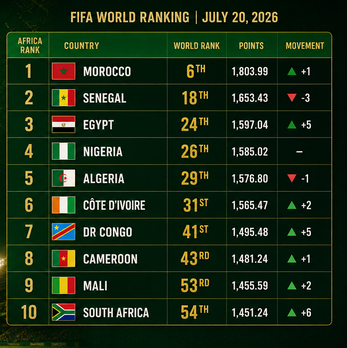
Africa’s Top 10 FIFA-Ranked Teams After the 2026 World Cup
| African Rank | Country | FIFA World Rank | Points | Movement |
|---|---|---|---|---|
| 1 | 🇲🇦 Morocco | 6th | 1,803.99 | +1 |
| 2 | 🇸🇳 Senegal | 18th | 1,653.43 | -3 |
| 3 | 🇪🇬 Egypt | 24th | 1,597.04 | +5 |
| 4 | 🇳🇬 Nigeria | 26th | 1,585.02 | — |
| 5 | 🇩🇿 Algeria | 29th | 1,576.80 | -1 |
| 6 | 🇨🇮 Côte d’Ivoire | 31st | 1,565.47 | +2 |
| 7 | 🇨🇩 DR Congo | 41st | 1,495.48 | +5 |
| 8 | 🇨🇲 Cameroon | 43rd | 1,481.24 | +1 |
| 9 | 🇲🇱 Mali | 53rd | 1,455.59 | +2 |
| 10 | 🇿🇦 South Africa | 54th | 1,451.24 | +6 |
Also Read: Check the official FIFA Men’s World Ranking
The July 20 ranking confirms Morocco as Africa’s No. 1 team, followed by Senegal, Egypt, Nigeria and Algeria. DR Congo, Cameroon, Mali and South Africa complete the continental top 10.
1. Morocco — Africa’s No. 1 and World No. 6 🇲🇦
Morocco are the biggest African success story in the latest FIFA ranking.
The Atlas Lions climbed from seventh to sixth in the world, collecting 48.89 additional ranking points and reaching 1,803.99 points.
That is the highest FIFA ranking ever achieved by an African men’s national team.
Morocco’s ranking rise followed another impressive World Cup campaign. After finishing strongly in the group stage, Morocco defeated Canada 3–0 in the Round of 16 and advanced to the quarter-finals, where they lost 2–0 to France.
Although Morocco did not repeat their historic 2022 semi-final appearance, reaching the last eight was enough to strengthen their position at the top of African football.
They now sit just behind Brazil in the global rankings, with fewer than one ranking point separating the two teams.
Morocco’s FIFA ranking
- World ranking: 6th
- African ranking: 1st
- Points: 1,803.99
- Previous world ranking: 7th
- Movement: +1
- World Cup finish: Quarter-finals
Morocco’s continued rise also reinforces the country’s growing reputation as one of the strongest national teams outside Europe’s traditional powers and South America’s elite.
2. Senegal — World No. 18 🇸🇳
Senegal remain Africa’s second-highest ranked national team despite falling three places in the global ranking.
The Teranga Lions finished the World Cup ranked 18th in the world, with 1,653.43 points.
Senegal entered the tournament as one of Africa’s strongest sides and had already established themselves as a major force after winning the Africa Cup of Nations.
However, their World Cup campaign ended in the Round of 32 after a 3–2 extra-time defeat to Belgium.
Despite the drop, Senegal remain firmly inside the global top 20.
Their No. 18 position also means Senegal remain significantly ahead of most African teams and continue to be one of the continent’s most competitive national sides.
3. Egypt — World No. 24 🇪🇬
Egypt produced one of the biggest ranking improvements among African teams.
The Pharaohs climbed five places to 24th in the world, gaining 34.68 ranking points.
Egypt’s improvement was largely driven by their performance at the 2026 World Cup, where they advanced to the Round of 16.
They defeated Australia 4–2 on penalties after a 1–1 draw in the Round of 32 before losing 3–2 to Argentina in the Round of 16.
Egypt’s rise to 24th means they have moved ahead of Nigeria and become Africa’s third-ranked team.
The result is particularly significant because Nigeria had been ranked higher than Egypt before the tournament.
4. Nigeria — World No. 26 🇳🇬
Nigeria remain one of Africa’s highest-ranked national teams despite not appearing at the 2026 World Cup.
The Super Eagles stayed at 26th in the world, with 1,585.02 points.
Nigeria’s unchanged position is largely explained by the fact that the team did not play at the World Cup and therefore did not earn or lose ranking points from the tournament.
Nigeria missed the expanded 48-team competition after losing to DR Congo in the African qualifying playoffs.
The situation creates an interesting contrast.
Nigeria remain ranked fourth in Africa and inside the world’s top 30, but Egypt moved ahead of them after gaining points at the World Cup.
For Nigeria, the next challenge will be converting their strong FIFA ranking into success in major competitions.
5. Algeria — World No. 29 🇩🇿
Algeria remain inside the global top 30 but slipped one position to 29th.
The Desert Foxes collected 1,576.80 points and remain fifth in Africa.
Their ranking is particularly impressive considering the competition among the continent’s leading sides.
Algeria are now separated from Nigeria by only three places in the global ranking.
6. Côte d’Ivoire — World No. 31 🇨🇮
Côte d’Ivoire climbed two places to 31st in the world after their World Cup campaign.
The Elephants collected 1,565.47 points and remain one of Africa’s strongest teams.
Côte d’Ivoire reached the Round of 32 before losing 2–1 to Norway.
Their two-place improvement demonstrates how World Cup performances can significantly influence FIFA rankings.
7. DR Congo — World No. 41 🇨🇩
DR Congo were among Africa’s biggest ranking climbers.
The Leopards jumped five places, moving from 46th to 41st in the world.
They also gained 21.05 ranking points.
DR Congo reached the Round of 32 at the World Cup, where they lost 2–1 to England.
Their rise is particularly notable because they moved ahead of Cameroon to become Africa’s seventh-ranked team.
8. Cameroon — World No. 43 🇨🇲
Cameroon moved up one place to 43rd in the world, despite not participating in the World Cup.
The Indomitable Lions remained on 1,481.24 points.
Their rise was therefore not caused by a World Cup performance. Instead, movement by other teams allowed Cameroon to climb one position globally.
However, Cameroon fell to eighth among African teams after DR Congo’s five-place rise.
9. Mali — World No. 53 🇲🇱
Mali moved up two places to 53rd in the world, with 1,455.59 points.
The Eagles were among the stronger African teams before the tournament but did not qualify for the 2026 World Cup.
Their ranking remains ahead of several African teams that participated in the tournament.
10. South Africa — World No. 54 🇿🇦
South Africa were one of Africa’s biggest FIFA ranking winners.
Bafana Bafana climbed six places, from 60th to 54th in the world.
That was the biggest improvement among Africa’s top 10 teams.
South Africa’s World Cup campaign ended in the Round of 32 after a 1–0 defeat to Canada.
Their rise means South Africa now sit immediately behind Mali and ahead of Tunisia.
The 54th position is also South Africa’s best FIFA ranking since January 2015, when they were ranked 52nd.
Also Read: See our Africa Cup of Nations winners guide
The Rest of Africa’s FIFA Rankings
Beyond the top 10, the latest ranking shows considerable differences between African national teams.
| African Rank | Country | World Rank |
| 11 | Tunisia | 57 |
| 12 | Burkina Faso | 62 |
| 13 | Cabo Verde | 64 |
| 14 | Ghana | 65 |
| 15 | Guinea | 81 |
| 16 | Gabon | 84 |
| 17 | Angola | 87 |
| 18 | Uganda | 89 |
| 19 | Zambia | 90 |
| 20 | Benin | 93 |
| 21 | Mozambique | 103 |
| 22 | Madagascar | 104 |
| 23 | Equatorial Guinea | 105 |
| 24 | Comoros | 108 |
| 25 | Kenya | 109 |
| 26 | Libya | 110 |
| 27 | Tanzania | 112 |
| 28 | Mauritania | 113 |
| 29 | Niger | 114 |
| 30 | Gambia | 116 |
| 31 | Sudan | 117 |
| 32 | Togo | 119 |
| 33 | Namibia | 121 |
| 34 | Sierra Leone | 122 |
| 35 | Rwanda | 128 |
| 36 | Malawi | 129 |
| 37 | Zimbabwe | 130 |
| 38 | Guinea-Bissau | 132 |
| 39 | Congo | 134 |
| 40 | Central African Republic | 139 |
| 41 | Liberia | 140 |
| 42 | Burundi | 142 |
| 43 | Ethiopia | 143 |
| 44 | Lesotho | 146 |
| 45 | Botswana | 147 |
| 46 | Eswatini | 165 |
| 47 | South Sudan | 169 |
| 48 | Mauritius | 178 |
| 49 | Chad | 183 |
| 50 | Eritrea | 184 |
| 51 | São Tomé and Príncipe | 195 |
| 52 | Djibouti | 196 |
| 53 | Somalia | 199 |
| 54 | Seychelles | 204 |
These positions come from the July 20, 2026 CAF/FIFA ranking dataset covering all 54 African national teams.
Ghana Was Africa’s Biggest Top-20 Climber
Ghana deserve special attention.
The Black Stars climbed eight places, from 73rd to 65th in the world, making them the biggest climber among the leading African teams.
Ghana also gained 40.12 FIFA ranking points.
The Black Stars’ World Cup campaign ended in the Round of 32 after a 1–0 defeat to Colombia, but their tournament performance was enough to produce a substantial ranking improvement.
Tunisia Suffered the Biggest Fall
While several African teams improved, Tunisia went in the opposite direction.
The Carthage Eagles dropped 12 places, falling from 45th to 57th.
They lost 49.82 ranking points, making Tunisia one of the biggest losers in the entire July ranking.
Also Read: Read more about African football history
Ranked: Leading Black-Majority and African-Diaspora Countries Outside Africa
FIFA does not have an official category called “Black countries.” For this comparison, the term is used descriptively to refer to selected Black-majority countries and countries strongly associated with African diaspora populations outside Africa.
This is separate from FIFA’s official continental rankings.
1. Brazil — World No. 5 🇧🇷
Brazil are the highest-ranked major football nation with a large Black and Afro-descendant population.
The Seleção climbed one place to fifth in the world, with 1,804.92 points.
Brazil finished ahead of Morocco by less than one ranking point.
Brazil’s fifth-place position means an African or African-diaspora national team now occupies two of the world’s top six positions when Morocco is included.
2. United States — World No. 16 🇺🇸
The United States finished the World Cup cycle ranked 16th in the world.
As a diverse nation with a substantial Black population and a large African diaspora, the US represents another important football market outside Africa.
The Americans reached the Round of 32 before losing 4–1 to Belgium.
3. Jamaica — World No. 71 🇯🇲
Jamaica remain one of the Caribbean’s strongest football nations.
The Reggae Boyz are ranked 71st in the world, with 1,357.84 points.
They remained unchanged from the previous FIFA ranking.
4. Haiti — World No. 88 🇭🇹
Haiti dropped five places to 88th in the world.
The Caribbean nation has 1,264.58 ranking points after losing 28.52 points in the latest update.
5. Trinidad and Tobago — World No. 102 🇹🇹
Trinidad and Tobago are ranked 102nd in the world.
The Soca Warriors remain one of the Caribbean’s historically important football nations, although their current ranking places them below Jamaica and Haiti.
6. Suriname — World No. 125 🇸🇷
Suriname are ranked 125th globally.
The South American nation has a strong historical connection to football in the Netherlands and a significant Afro-Surinamese population.
7. Barbados — World No. 179 🇧🇧
Barbados are ranked 179th in the FIFA men’s ranking.
The Bajan Tridents remain one of the Caribbean’s smaller national teams in terms of FIFA ranking position.
FIFA World Ranking: Africa vs the World’s Leading Black Football Nations
Looking at the highest-ranked teams gives an interesting picture:
| Team | Region | FIFA World Rank |
| Brazil | South America | 5 |
| Morocco | Africa | 6 |
| Senegal | Africa | 18 |
| Egypt | Africa | 24 |
| Nigeria | Africa | 26 |
| Algeria | Africa | 29 |
| Côte d’Ivoire | Africa | 31 |
| DR Congo | Africa | 41 |
| Cameroon | Africa | 43 |
| Mali | Africa | 53 |
| South Africa | Africa | 54 |
| Ghana | Africa | 65 |
| Jamaica | Caribbean | 71 |
| Haiti | Caribbean | 88 |
| Trinidad & Tobago | Caribbean | 102 |
| Suriname | South America | 125 |
| Barbados | Caribbean | 179 |
The comparison shows the extraordinary strength of African football at the top end of the FIFA rankings.
Morocco are sixth globally, while Senegal, Egypt, Nigeria, Algeria and Côte d’Ivoire all sit inside the world’s top 31.
Morocco’s Historic Rise Is the Biggest African Story
The biggest story from the post-World Cup ranking is undoubtedly Morocco.
The Atlas Lions were already Africa’s highest-ranked team before the tournament, but their quarter-final appearance pushed them to an unprecedented sixth place in the world.
Morocco’s ranking has risen dramatically in recent years.
FIFA’s January 2026 ranking had Morocco eighth in the world after their strong AFCON campaign, and the team subsequently climbed to seventh before the World Cup.
Their latest sixth-place position means Morocco are now just one place away from the world’s top five.
Read about Morocco’s FIFA ranking rise
Africa’s 2026 World Cup Performance
The 2026 World Cup also demonstrated that African teams can compete with some of the strongest national sides in world football.
Morocco reached the quarter-finals.
Egypt reached the Round of 16.
Côte d’Ivoire, Ghana, DR Congo and South Africa all advanced to the knockout stage.
Senegal also reached the knockout phase.
However, several of Africa’s highest-ranked teams before the tournament did not qualify, including Nigeria, Cameroon, Mali and Burkina Faso.
This created an unusual situation in the FIFA rankings: some teams gained places despite not playing at the World Cup, while others dropped despite participating.
Biggest African FIFA Ranking Climbers After the World Cup
The World Cup produced several major African ranking gains.
Ghana: +8 places
Ghana climbed from 73rd to 65th.
South Africa: +6 places
Bafana Bafana rose from 60th to 54th.
DR Congo: +5 places
The Leopards moved from 46th to 41st.
Egypt: +5 places
The Pharaohs climbed from 29th to 24th.
Côte d’Ivoire: +2 places
The Elephants moved from 33rd to 31st.
Mali: +2 places
Mali rose from 55th to 53rd.
Biggest African FIFA Ranking Drop
Tunisia recorded the biggest decline.
The Carthage Eagles fell 12 places, from 45th to 57th.
That was the largest drop among African teams in the July 20 ranking.
Their 49.82-point decline was a major contrast to the gains made by Ghana, South Africa, Egypt and DR Congo.
What the New FIFA Rankings Mean for African Football
The latest ranking suggests that African football is becoming increasingly competitive at the international level.
Morocco’s sixth-place position is particularly significant because it puts an African team directly among the world’s traditional football powers.
At the same time, the gap between the leading African nations is narrowing.
Senegal are 18th, Egypt 24th, Nigeria 26th and Algeria 29th. Côte d’Ivoire are only two places outside the global top 30.
This means Africa currently has six teams ranked inside the world’s top 31.
That is a major improvement in the continent’s global football standing.
The next challenge is turning strong FIFA rankings into deeper World Cup runs.
Morocco came closest by reaching the quarter-finals, but the continent will want to see an African team return to the semi-finals — and eventually challenge for the World Cup title.
Final Ranking: Africa’s Top 10 After the 2026 World Cup
- 🇲🇦 Morocco — 6th in the world
- 🇸🇳 Senegal — 18th
- 🇪🇬 Egypt — 24th
- 🇳🇬 Nigeria — 26th
- 🇩🇿 Algeria — 29th
- 🇨🇮 Côte d’Ivoire — 31st
- 🇨🇩 DR Congo — 41st
- 🇨🇲 Cameroon — 43rd
- 🇲🇱 Mali — 53rd
- 🇿🇦 South Africa — 54th
The July 20, 2026 FIFA ranking confirms Morocco as the undisputed No. 1 team in Africa, while Senegal, Egypt, Nigeria, Algeria and Côte d’Ivoire form the continent’s next tier.
Conclusion
The post-2026 World Cup FIFA rankings have delivered a powerful statement about the current state of African football.
Morocco’s historic sixth-place ranking is the headline, but the broader picture is even more encouraging. Six African nations are now inside the world’s top 31, while Ghana, South Africa and DR Congo were among the tournament’s biggest ranking climbers.
For Nigeria, the story is more complicated. The Super Eagles remain a top-30 team despite missing the World Cup, but Egypt’s strong tournament performance has pushed the Pharaohs above them in the African rankings.
Meanwhile, Ghana’s rise to 65th, South Africa’s jump to 54th and DR Congo’s climb to 41st show that the continent’s middle tier is also becoming increasingly competitive.
If Morocco, Senegal, Egypt, Nigeria, Algeria, Côte d’Ivoire and the next generation of African football powers can continue this progress, the question may no longer be whether an African nation can win the World Cup — but when.
Related Articles
- Complete List of All CAF African Footballers of the Year
- Winners of the Africa Cup of Nations from 1957 to 2021
- Nigeria Country Profile: Population, History, Economy, Culture & Geography
- How Pele Ended a War in Africa
- FIFA World Cup 2026 knockout-stage results
Sources: FIFA/Coca-Cola Men’s World Ranking, FIFA World Cup 2026 match records, and supporting national and football ranking sources. The ranking figures in this article refer specifically to the official July 20, 2026 FIFA update.