MKO Abiola Biography: Life, Business Empire, June 12 Election, Death and Legacy

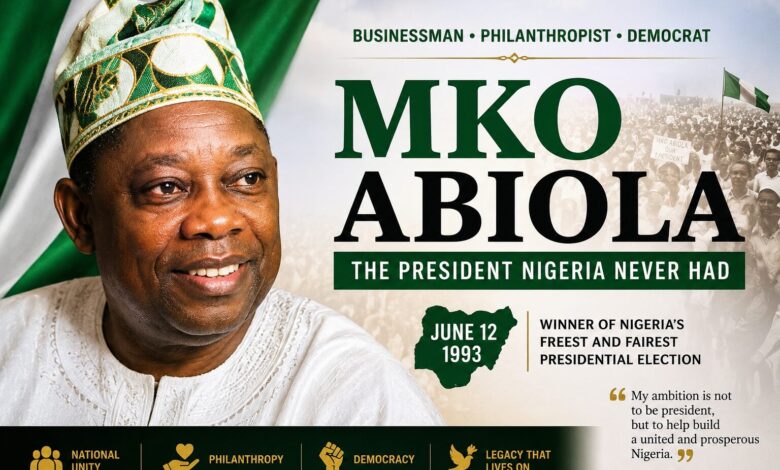
Chief Moshood Kashimawo Olawale Abiola, popularly known as MKO Abiola, was one of the most influential figures in Nigeria’s modern history. A successful businessman, publisher, philanthropist, and politician, Abiola is best remembered as the presumed winner of Nigeria’s historic June 12, 1993 presidential election.
Although he never officially assumed office, many Nigerians regard him as the symbol of democracy and the man who paid the ultimate price for democratic governance in Nigeria. His life story is one of determination, success, philanthropy, political struggle, and sacrifice.
Early Life and Background
MKO Abiola was born into a modest Yoruba Muslim family in Abeokuta, Ogun State. His father, Salawu Abiola, worked as a produce trader, while his mother, Zeliat Wuraola Abiola, was known for her strong commitment to family and community.
Growing up during the colonial era, Abiola witnessed firsthand the economic and social challenges faced by ordinary Nigerians. These experiences would later influence his commitment to philanthropy and national development.
Despite financial difficulties, his parents placed a high value on education and encouraged him to pursue academic excellence.
Childhood and Entrepreneurial Spirit
As a child, Abiola displayed remarkable intelligence and business acumen. To support himself and contribute to his family’s income, he engaged in small trading activities and sold firewood and other goods.
His determination and hard work earned him the nickname “the child who refused to be limited by poverty.”
These early experiences helped shape the resilience and ambition that would later define his business career.
Education
Abiola attended African Central School in Abeokuta before proceeding to secondary education. His academic brilliance earned him scholarships that eventually took him to Scotland.
He studied at the University of Glasgow, where he graduated in Accountancy in 1963. He later qualified as a Chartered Accountant, laying the foundation for his future business success.
Business Career
After returning to Nigeria, Abiola built one of Africa’s largest private business empires.
He joined International Telephone and Telegraph (ITT) Nigeria and rapidly rose through the ranks. By the 1970s, he had become one of the company’s top executives and later expanded into various industries including:
- Telecommunications
- Publishing
- Aviation
- Banking
- Oil and Gas
- Shipping
- Agriculture
His business interests extended across Africa, Europe, and the Middle East. By the late 1980s, he was recognized internationally as one of Africa’s most successful businessmen.
At a time when few Africans owned multinational companies, Abiola emerged as a symbol of African entrepreneurship and economic success.
Role in ITT Corporation
One of Abiola’s greatest business achievements was his rise within International Telephone and Telegraph (ITT).
He became Vice President of ITT Africa and Middle East, overseeing operations across multiple countries.
His success at ITT brought him international recognition and helped establish valuable relationships with political and business leaders around the world.
Philanthropy and Social Impact
MKO Abiola’s philanthropy earned him admiration across Nigeria and beyond.
He funded:
- Schools and educational programs
- Churches and mosques
- Libraries
- Community development projects
- Scholarships for thousands of students
- Sports development initiatives
His charitable activities crossed ethnic, religious, and regional boundaries. Many communities across Nigeria benefited from his generosity regardless of tribe or faith.
Because of his influence and service to society, Abiola was conferred with the prestigious Yoruba title of Aare Ona Kakanfo of Yorubaland in 1987.
Why MKO Abiola Was Called Africa’s Greatest Philanthropist
Abiola’s generosity became legendary.
He donated millions of dollars to:
- Educational institutions
- Religious organizations
- Community projects
- Sports associations
- Scholarship schemes
- Healthcare initiatives
Many beneficiaries had never met him personally.
Unlike many wealthy individuals, his charitable giving crossed religious and ethnic boundaries.
He funded churches despite being Muslim and contributed to Islamic institutions while supporting Christian organizations.
This earned him respect across Nigeria’s diverse communities.
Support for Sports
Abiola played a major role in Nigerian sports development.
He sponsored football competitions and provided financial assistance to athletes and sports organizations.
His support helped improve sports infrastructure and increased opportunities for young athletes.
Entry into Politics
Although already influential in business and public life, Abiola formally entered politics during Nigeria’s transition to civilian rule in the early 1990s.
He joined the Social Democratic Party (SDP) and emerged as its presidential candidate ahead of the 1993 election.
His running mate was Ambassador Babagana Kingibe. Together they campaigned on a platform focused on national unity, economic growth, and poverty reduction.
The June 12, 1993 Presidential Election
The June 12, 1993 election is widely regarded as Nigeria’s freest and fairest election.
Abiola’s candidacy attracted support across ethnic, religious, and regional lines. He won votes in northern and southern Nigeria, among Christians and Muslims alike—a rare achievement in Nigerian politics.
Preliminary results showed that Abiola was heading toward a decisive victory.
However, before the final results could be officially announced, the military government of General Ibrahim Babangida annulled the election, triggering one of the biggest political crises in Nigerian history.
Why June 12 Matters
The annulment of the election led to nationwide protests, civil unrest, and increased demands for democracy.
For many Nigerians, June 12 became a symbol of the struggle against military rule and the fight for democratic governance.
The June 12, 1993 election represented a turning point in Nigerian politics.
For the first time in modern Nigerian history:
- Religious divisions were largely ignored.
- Ethnic politics became less important.
- Nigerians voted overwhelmingly based on competence rather than identity.
Abiola, a southern Muslim, selected Babagana Kingibe, a northern Muslim, as his running mate.
Despite concerns about a Muslim-Muslim ticket, Nigerians across the country supported the SDP candidate.
This demonstrated an unprecedented level of national unity.
Election Results
Although the results were never officially completed, available figures showed that Abiola won:
- Most states in Southern Nigeria.
- Several states in Northern Nigeria.
- The Federal Capital Territory.
Observers concluded that he had secured a clear national mandate.
Many historians consider June 12 the fairest election in Nigerian history.
The Symbol of Democratic Resistance
After the election was annulled, Abiola refused to abandon his claim.
Instead, he embarked on a campaign demanding recognition of the people’s mandate.
His refusal to compromise transformed him from businessman and politician into a symbol of democratic resistance.
Thousands of Nigerians joined pro-democracy movements inspired by his determination.
Declaration as President
On June 11, 1994, Abiola declared himself the rightful President of Nigeria based on the mandate he claimed to have won in the June 12 election.
The military government of General Sani Abacha viewed this declaration as a challenge to its authority.
Shortly afterward, Abiola was arrested and charged with treason.
Arrest and Detention
Following his arrest, Abiola spent four years in detention.
His imprisonment became a rallying point for pro-democracy activists both within Nigeria and internationally.
Several groups and prominent individuals demanded his release, arguing that he had been denied the presidency that Nigerians freely voted for.
Despite international pressure, he remained incarcerated during most of General Sani Abacha’s rule.
Death
On July 7, 1998, MKO Abiola died unexpectedly in Abuja while still in detention.
His death occurred just weeks after the sudden death of General Sani Abacha and during negotiations that could have led to his release.
The official cause of death was reported as a heart attack, although his death has remained the subject of public debate and speculation.
He was 60 years old.
Legacy
Today, MKO Abiola is remembered as one of the most important figures in Nigeria’s democratic history.
In June 2018, President Muhammadu Buhari officially recognized MKO Abiola’s contribution to democracy.
June 12 was declared Nigeria’s Democracy Day, replacing May 29.
Abiola was also posthumously awarded the prestigious Grand Commander of the Federal Republic (GCFR), an honour traditionally reserved for Nigerian presidents.
This recognition cemented his place as one of Nigeria’s most important democratic icons.
Many historians believe that Abiola’s sacrifice helped pave the way for Nigeria’s return to democratic rule in 1999.
MKO Abiola at a Glance
| Detail | Information |
|---|---|
| Full Name | Moshood Kashimawo Olawale Abiola |
| Popular Name | MKO Abiola |
| Date of Birth | August 24, 1937 |
| Place of Birth | Abeokuta, Ogun State, Nigeria |
| Occupation | Businessman, Politician, Publisher, Philanthropist |
| Political Party | Social Democratic Party (SDP) |
| Running Mate | Babagana Kingibe |
| Major Election | June 12, 1993 Presidential Election |
| Date of Death | July 7, 1998 |
| National Honour | GCFR (Posthumous) |
Conclusion
MKO Abiola’s life remains one of the most compelling stories in African political history. Rising from humble beginnings to become a global businessman and national political figure, he left a lasting mark on Nigeria.
His victory in the June 12 election and the struggle that followed transformed him into a symbol of democracy, justice, and national unity.
More than two decades after his death, his legacy continues to shape discussions about democracy, governance, and political rights in Nigeria.
FAQ Section
What does MKO stand for?
MKO stands for Moshood Kashimawo Olawale.
Why is MKO Abiola famous?
He is famous for winning the annulled June 12, 1993 presidential election and becoming a symbol of democracy in Nigeria.
Did MKO Abiola become President?
No. Although he is widely believed to have won the election, the results were annulled before he could assume office.
Why was MKO Abiola arrested?
He was arrested after declaring himself the rightful president of Nigeria following the annulment of the June 12 election.
Why is June 12 celebrated in Nigeria?
June 12 commemorates the 1993 presidential election and honours MKO Abiola’s role in Nigeria’s democratic struggle.
What was MKO Abiola’s net worth?
While exact figures remain unknown, he was regarded as one of Africa’s wealthiest businessmen during the 1980s and 1990s.