Africa Before Colonization: Powerful Kingdoms That Shaped History

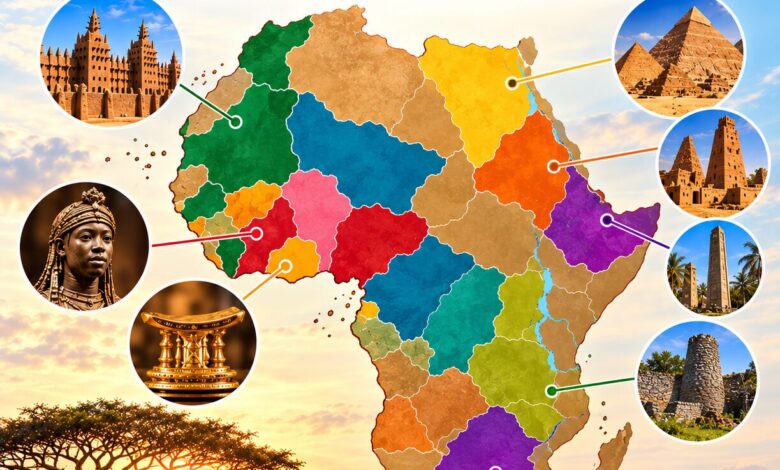
From the gold-rich cities of West Africa to the ancient civilizations of the Nile Valley, from the trading ports of East Africa to the powerful kingdoms of Southern Africa, the continent was home to some of the world’s most influential societies.
These African kingdoms developed systems of government, established international trade networks, built impressive architectural monuments, and contributed to advances in mathematics, astronomy, medicine, agriculture, and education.
By the time European powers gathered at the Berlin Conference in 1884–1885, Africa was not an empty continent waiting to be governed. It was a vast region of established states, communities, political institutions, and cultural traditions.
To understand the full impact of European colonization, it is important to explore the powerful African kingdoms and empires that existed long before colonial borders were drawn.
1. The Mali Empire: One of the Wealthiest Empires in History


The Mali Empire was one of the most influential civilizations in medieval African history.
Established in the 13th century, the empire rose to prominence under Sundiata Keita, who is traditionally credited with founding the empire following his victory at the Battle of Kirina around 1235.
At its height, Mali controlled extensive territories across West Africa, including parts of present-day Mali, Senegal, Guinea, Mauritania, Niger, and neighbouring regions.
Its wealth came largely from gold production, agriculture, and its strategic position along trans-Saharan trade routes.
Mansa Musa and the wealth of Mali
One of Mali’s most famous rulers was Mansa Musa, who governed during the 14th century.
Mansa Musa became internationally renowned following his pilgrimage to Mecca in 1324. His journey through North Africa attracted widespread attention because of the extraordinary amount of gold and the large entourage accompanying him.
Historical accounts describe his generous distribution of gold in Cairo, which reportedly affected the metal’s local value.
Although it is impossible to calculate his wealth accurately in modern currency, Mansa Musa remains one of history’s most celebrated examples of royal prosperity.
Beyond wealth, Mali became an important centre of Islamic scholarship, particularly in Timbuktu.
The city developed a strong tradition of manuscript production, religious education, legal studies, and intellectual exchange.
The legacy of Mali demonstrates that medieval Africa participated actively in international commerce, diplomacy, and scholarship.
2. The Songhai Empire: West Africa’s Great Trading Power


Following the decline of Mali, the Songhai Empire emerged as one of the largest states in African history.
Its political and commercial centre was Gao, located along the Niger River.
During the 15th and 16th centuries, Songhai expanded significantly under rulers such as Sunni Ali and Askia Muhammad I.
Sunni Ali, who ruled from 1464 to 1492, expanded Songhai’s influence through military campaigns and brought important commercial centre, including Timbuktu and Djenné, under his authority.
Askia Muhammad, who came to power in 1493, strengthened administrative institutions and encouraged Islamic learning.
Trade, education, and political organization
Songhai’s prosperity depended on controlling important trade routes connecting West Africa with North Africa.
Gold, salt, textiles, and other commodities moved through its commercial networks.
The Niger River provided an important transportation route, connecting agricultural settlements with urban markets.
Timbuktu continued to flourish as a centre of scholarship, attracting teachers, students, and merchants.
The empire eventually declined following the Moroccan invasion of 1591, when Moroccan forces defeated Songhai’s army at the Battle of Tondibi.
Songhai’s history illustrates the scale of political organization and economic activity that existed in West Africa centuries before European colonial rule.
3. The Kingdom of Benin: Masters of Art and Urban Civilization


In present-day southern Nigeria, the Kingdom of Benin developed into one of West Africa’s most sophisticated precolonial states.
The kingdom’s political traditions developed over many centuries, with the Oba serving as its central ruler.
Benin City became an important political, commercial, and artistic centre.
Its royal court supported highly skilled craftspeople who produced intricate works in brass, bronze, ivory, wood, and other materials.
Today, these creations are internationally recognized as the Benin Bronzes.
Despite their name, the Benin Bronzes include thousands of objects made from different materials, especially brass.
A kingdom known for extraordinary craftsmanship
The artworks documented royal ceremonies, historical events, military achievements, and the kingdom’s spiritual traditions.
Benin was also associated with extensive defensive earthworks, including walls, ditches, and embankments built across the surrounding region.
These structures reflected the kingdom’s capacity to organize labour and maintain large settlements.
European visitors encountered Benin’s established political and commercial institutions long before Britain conquered the kingdom in 1897.
During the British military expedition that year, thousands of royal artworks were looted and subsequently dispersed into museums and private collections around the world.
The continuing international debate over the restitution of the Benin Bronzes highlights how Africa’s precolonial heritage remains connected to contemporary questions about colonialism and cultural ownership.
4. Ancient Egypt: One of the World’s Earliest Great Civilizations


No examination of Africa’s ancient civilizations would be complete without Ancient Egypt.
Emerging along the Nile River more than 5,000 years ago, ancient Egyptian civilization became one of the longest-lasting and most influential civilizations in human history.
Its rulers established centralized political institutions, organized agricultural production, developed writing systems, and commissioned monumental architecture.
The pyramids of Giza remain among the world’s most recognizable ancient structures.
Egyptian society also made significant contributions to mathematics, engineering, medicine, astronomy, and calendar development.
The importance of the Nile
The Nile River was central to Egypt’s development.
Seasonal flooding deposited fertile soil along its banks, supporting agricultural production and population growth.
Egyptian rulers used the country’s agricultural wealth to maintain armies, administer territories, and construct temples, palaces, and monuments.
Ancient Egypt maintained diplomatic and commercial relationships with neighbouring African societies and regions beyond the continent.
Its history reminds us that Africa was central to the development of some of humanity’s earliest complex states.
5. The Kingdom of Kush: The African Civilization That Ruled Egypt


South of ancient Egypt, in present-day Sudan, the Kingdom of Kush emerged as a powerful civilization in the Nile Valley.
Kush developed important political centres at Napata and later Meroë.
The kingdom maintained close cultural, religious, and commercial relationships with Egypt while preserving its own political identity and traditions.
During the eighth century BCE, Kushite rulers conquered Egypt and established its 25th Dynasty.
These rulers, sometimes called the Black Pharaohs, governed Egypt for several decades.
The pyramids of Sudan
One of Kush’s most remarkable legacies is its pyramid-building tradition.
The region around Meroë contains numerous royal pyramids, many of which were constructed centuries after Egypt’s famous pyramids at Giza.
Kush also developed significant ironworking traditions and participated in trade networks connecting north-eastern Africa with other regions.
The kingdom’s history challenges the idea that ancient civilization in the Nile Valley was limited to Egypt.
Instead, the Nile supported several interconnected African civilizations that influenced one another over many centuries.
6. The Kingdom of Aksum: An African Power Connected to the Ancient World


The Kingdom of Aksum emerged in the Horn of Africa, primarily in the territories of present-day Ethiopia and Eritrea.
Between approximately the first and seventh centuries CE, Aksum became a major commercial and political power.
Its strategic position near the Red Sea enabled merchants to participate in trade networks connecting Africa, Arabia, the Mediterranean, and the Indian Ocean.
Aksum exported commodities such as ivory and other regional products while importing manufactured goods and luxury items.
The kingdom also issued its own coins, demonstrating the sophistication of its commercial institutions.
Christianity and Aksum’s cultural legacy
During the fourth century, King Ezana adopted Christianity, helping establish one of the world’s oldest enduring Christian traditions.
Aksum is also famous for its monumental stone stelae, some of which remain standing today.
These impressive structures demonstrate advanced stone-working and engineering skills.
The civilization’s legacy remains deeply connected to Ethiopian and Eritrean history.
Aksum provides important evidence that ancient African states were active participants in international trade and cultural exchange.
7. Great Zimbabwe: The Stone City of Southern Africa


In Southern Africa, Great Zimbabwe stands as one of the continent’s most impressive archaeological sites.
The settlement flourished primarily between the 11th and 15th centuries.
It became the centre of a powerful state supported by cattle ownership, agriculture, gold production, and long-distance trade.
Its most famous structures include the Great Enclosure and the Hill Complex.
The massive stone walls were constructed without mortar, using carefully arranged granite blocks.
A centre of African trade
Archaeological discoveries at Great Zimbabwe include imported ceramics and other objects demonstrating connections with Indian Ocean trade networks.
Gold and other regional resources moved through commercial routes linking the interior of Southern Africa with coastal trading cities.
Great Zimbabwe was built by the ancestors of Shona-speaking peoples.
During the colonial era, some European writers attempted to attribute the ruins to outsiders rather than acknowledging their African origins.
Modern archaeological research has firmly established Great Zimbabwe as an achievement of indigenous African civilization.
Its architecture remains an enduring symbol of Africa’s precolonial political and engineering capabilities.
8. The Oyo Empire: A Powerful Yoruba State


The Oyo Empire became one of the most influential Yoruba states in West Africa.
Centred in the region of present-day southwestern Nigeria, Oyo expanded considerably during the 17th and 18th centuries.
Its political structure combined royal authority with powerful institutions that placed limits on the Alaafin, the empire’s ruler.
The Oyo Mesi, a council of leading political figures, played an important role in governance.
This arrangement demonstrates that African political systems often included complex mechanisms for consultation, accountability, and the distribution of authority.
Military strength and regional influence
Oyo was particularly known for its cavalry forces, which enabled the empire to project military power across suitable areas of the West African savanna.
Its influence extended into parts of present-day Benin and surrounding regions.
Trade, agriculture, tribute, and regional commerce supported the empire’s economy.
However, Oyo’s history also included warfare and involvement in the Atlantic slave trade, illustrating that precolonial African states, like states elsewhere, had complex and sometimes violent political histories.
Internal struggles and regional conflicts contributed to the empire’s decline during the 19th century.
Nevertheless, Oyo’s political institutions and cultural traditions remain important to Yoruba history.
9. The Asante Empire: Gold, Political Power, and Resistance


In present-day Ghana, the Asante Empire emerged as a major political and military power around the beginning of the 18th century.
Under the leadership of Osei Tutu I and the influential priest and adviser Okomfo Anokye, several Akan-speaking states were brought together into a powerful political union.
The Golden Stool became a central symbol of Asante unity, authority, and identity.
The empire’s capital, Kumasi, developed into an important centre of political administration and commerce.
Gold and international commerce
The Asante controlled access to valuable gold-producing regions and participated in extensive regional and Atlantic trade networks.
Gold helped support royal authority, commercial activity, and military expansion.
The empire also developed distinctive artistic traditions, including gold-weights, metalwork, textiles, and royal regalia.
During the 19th century, Asante fought a series of wars against British forces as both sides sought greater influence over the region.
Although Britain eventually imposed colonial control, Asante institutions and cultural traditions survived.
The Asante kingdom continues to hold important ceremonial and cultural significance in modern Ghana.
10. The Kingdom of Kongo: Central Africa’s Influential State


The Kingdom of Kongo emerged in Central Africa before the arrival of Portuguese explorers in the late 15th century.
Its territories extended across parts of present-day Angola, the Democratic Republic of the Congo, and the Republic of the Congo.
The kingdom’s capital, Mbanza Kongo, served as an important administrative and cultural centre.
Kongo had an organized political system headed by a monarch, supported by provincial authorities and local institutions.
Diplomacy with Europe
When Portuguese explorers reached the region in the 1480s, they encountered an established kingdom with its own political hierarchy and commercial networks.
Diplomatic relations developed between Kongo and Portugal, and Christianity became influential within the royal court.
King Afonso I, who ruled during the early 16th century, maintained correspondence with Portuguese authorities and sought to strengthen the kingdom’s institutions.
However, relations became increasingly complicated by the expansion of the Atlantic slave trade.
Political conflict, foreign intervention, and internal divisions weakened the kingdom over time.
Kongo’s history illustrates that relations between African and European powers initially included diplomacy and negotiation, not simply European colonial administration.
11. The Swahili City-States: Africa’s Gateway to the Indian Ocean


Along the East African coast, a network of prosperous Swahili city-states developed over many centuries.
Important settlements included Kilwa, Mombasa, Malindi, Lamu, and other coastal communities.
These cities were not united under a single empire. Instead, they formed a collection of independent or semi-independent commercial centres.
Their inhabitants developed a distinctive Swahili culture rooted in African societies and shaped by centuries of interaction across the Indian Ocean.
Trade across continents
Swahili merchants traded with communities in Arabia, Persia, India, and other regions connected to Indian Ocean commerce.
Exports included gold, ivory, and other products from the African interior.
Imports included ceramics, textiles, and luxury goods.
Kilwa became especially prosperous because of its connections with gold-producing regions in south-eastern Africa.
The development of Swahili architecture, urban culture, and the Swahili language reflects the influence of these commercial relationships.
The Swahili city-states demonstrate that East Africa was deeply connected to global economic networks long before the colonial period.
12. The Zulu Kingdom: Military Organization and State Formation


In Southern Africa, the Zulu Kingdom became a major regional power during the early 19th century.
Under King Shaka Zulu, who ruled from approximately 1816 to 1828, the kingdom underwent significant military and political transformation.
Shaka consolidated authority over several communities and helped establish a powerful centralized state.
Zulu military organization became renowned for its disciplined regiments, battlefield tactics, and use of close-combat weapons.
Resistance to British expansion
During the later 19th century, the Zulu Kingdom faced growing pressure from British colonial expansion.
In 1879, Zulu forces defeated a British army at the Battle of Isandlwana, one of the most significant African victories against British imperial forces during the colonial era.
Although the British ultimately defeated the Zulu Kingdom in the same war, the Battle of Isandlwana remains an important example of African military resistance.
Zulu history demonstrates how African states adapted their political and military institutions in response to changing regional conditions.
Africa Was Never a Continent Without Civilization
The kingdoms and empires discussed above represent only a fraction of Africa’s precolonial history.
Other important civilizations and political societies included the Hausa city-states, Kanem-Bornu Empire, Dahomey Kingdom, Luba Kingdom, Lunda Empire, Mutapa State, Buganda Kingdom, and numerous other communities.
Africa’s political landscape was extraordinarily diverse.
Some societies were governed by powerful monarchies, while others operated through councils, federations, age-grade institutions, clan systems, or decentralized political arrangements.
Africa also contained extensive networks of agricultural settlements, pastoral communities, and commercial towns that did not necessarily belong to large empires.
This diversity is essential to understanding African history.
Political power was not limited to kings and emperors, and historical achievements were not restricted to societies that constructed monumental buildings.
African communities developed technologies, cultural institutions, ecological knowledge, and systems of social organization suited to their environments.
Their histories deserve recognition alongside those of the continent’s most famous kingdoms.
The Scramble for Africa: How European Powers Divided the Continent


By the late 19th century, European industrial powers were increasingly competing for territories, resources, trade routes, and political influence across Africa.
Although European merchants, missionaries, and military forces had operated in parts of Africa for centuries, the scale of territorial conquest accelerated dramatically after the 1870s.
The period became known as the Scramble for Africa.
Britain, France, Germany, Belgium, Portugal, Italy, and Spain sought control over different regions of the continent.
The Berlin Conference of 1884–1885, organized under German Chancellor Otto von Bismarck, established rules intended to manage European colonial competition.
Contrary to a common misconception, the conference did not draw all of Africa’s modern borders in a single meeting.
Instead, it helped formalize principles for European territorial claims and accelerated a process of conquest and partition carried out through later treaties, negotiations, and military campaigns.
African rulers and representatives were excluded from the conference.
How colonization transformed African political systems
European conquest disrupted many existing African institutions.
Some kingdoms were defeated militarily and incorporated into colonial territories.
Others retained traditional rulers, but their authority was increasingly subordinated to colonial administrations.
Colonial boundaries often divided communities with shared languages, histories, and cultural traditions.
At the same time, some colonial territories brought historically separate political societies under a single administration.
These changes contributed significantly to the borders inherited by many African countries at independence.
Colonial economies also redirected resources, labour, and trade toward imperial priorities.
Although the experiences of African societies varied widely, European colonial rule fundamentally transformed the continent’s political and economic structures.
Ethiopia and Liberia: The Exceptions to the Colonial Partition
Two African states are commonly identified as having maintained their independence during the main period of European partition: Ethiopia and Liberia.
Ethiopia successfully defeated an Italian invasion at the Battle of Adwa in 1896, preserving its sovereignty during the Scramble for Africa.
However, Italy later occupied Ethiopia between 1936 and 1941.
Liberia declared independence in 1847 and was not formally colonized by a European power during the Scramble, although its history was shaped by the settlement of formerly enslaved and free-born Black people from the United States, and by strong external economic and political pressures.
Both countries occupied distinctive positions in Africa’s transition from precolonial political systems to the modern era.
What Happened to Africa’s Great Kingdoms?
European colonization did not erase the continent’s earlier history, but it changed the political position of many traditional institutions.
Some kingdoms ceased to exist as independent states.
Others survived as cultural and ceremonial institutions within modern African countries.
The Asantehene continues to play a major traditional role in Ghana, while the Oba of Benin remains an important figure in Edo cultural life.
Traditional institutions also continue to shape communities across Nigeria, Uganda, South Africa, and other African countries.
Meanwhile, historical monuments and archaeological sites preserve evidence of earlier civilizations.
The pyramids of Meroë, the ruins of Great Zimbabwe, the stelae of Aksum, and the manuscripts of Timbuktu remain powerful reminders of Africa’s long history of state formation, scholarship, trade, and artistic achievement.
Efforts to recover looted cultural objects, protect archaeological sites, and expand African historical research have also brought renewed international attention to these civilizations.
Why Understanding Precolonial African History Matters Today
Studying Africa before colonization is not simply about celebrating powerful kings or wealthy empires.
It is about understanding the continent’s place in world history.
African civilizations developed through their own internal political, economic, and cultural processes while also maintaining connections with societies beyond the continent.
Their histories included prosperity and conflict, innovation and inequality, diplomacy and warfare.
Recognizing this complexity is important because it avoids replacing one oversimplified historical narrative with another.
Africa was neither a continent without civilization before European conquest nor a collection of uniformly peaceful and prosperous kingdoms.
It was a diverse continent whose societies experienced centuries of change, adaptation, competition, and achievement.
Understanding these histories also provides context for contemporary debates about African identity, cultural heritage, political borders, and economic development.
Many modern African societies continue to draw upon institutions, languages, and cultural traditions that existed long before colonial rule.
Conclusion: Africa’s History Did Not Begin With Colonization
Before European powers divided Africa into colonial territories, the continent had already witnessed the rise and decline of remarkable civilizations.
The Mali Empire built its prosperity on gold and international commerce.
Songhai developed one of West Africa’s largest political systems.
The Kingdom of Benin became internationally renowned for its extraordinary artistic traditions.
Kushite rulers governed Egypt, while Aksum connected north-eastern Africa with the ancient world’s commercial networks.
Great Zimbabwe demonstrated advanced architectural and economic organization in Southern Africa.
The Oyo and Asante empires developed influential political and military institutions, while the Swahili city-states connected African societies with Indian Ocean trade.
These civilizations were not isolated exceptions. They were part of a much broader history of African achievement.
European colonialism dramatically changed Africa’s political map, but it did not create the continent’s history, its cultures, or its civilizations.
Africa’s history began long before colonial borders were drawn, and the legacies of its powerful kingdoms continue to shape the continent today.
Sources and further reading
For readers interested in exploring the history of precolonial African civilizations, the following institutions provide useful research materials and historical resources.
-
UNESCO – General History of Africa: A comprehensive historical project documenting African societies from prehistory to the modern era.
-
The Metropolitan Museum of Art – Heilbrunn Timeline of Art History: Research on African art, civilizations, and cultural traditions.
-
British Museum Collection: Historical artifacts and research materials related to African kingdoms, including Benin, Asante, and ancient Egypt.
-
UNESCO – Great Zimbabwe National Monument: Archaeological and historical information about Great Zimbabwe.
-
Library of Congress: Historical maps, manuscripts, and research collections covering African history and European colonialism.