Today in Black History — Biography Life (Booker T. Washington, Chinua Achebe)

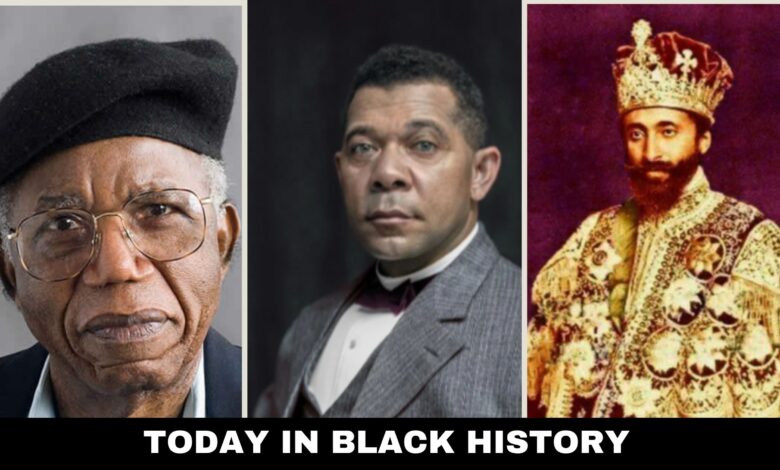
Exploring global Black achievements, civil rights milestones, African leadership, and cultural breakthroughs that took place on this significant date.
November 16 is filled with historic moments that span African American progress, African independence, global Black leadership, political milestones, literature, sports, culture, and resistance against oppression.
Below is a comprehensive breakdown of the key Black history events that happened on November 16.
1. Booker T. Washington Dines at the White House (1901)
On November 16, 1901, Booker T. Washington, founder of Tuskegee Institute and one of the most influential African American leaders of the 19th century, dined with President Theodore Roosevelt at the White House.
Why This Was Historic
-
First time an African American was invited to dine at the White House as a guest.
-
Symbolized political acknowledgment at a time of severe segregation.
-
Triggered national debate and backlash, exposing deep racial tensions of Jim Crow America.
Learn More:
🔗 https://www.whitehousehistory.org/booker-t-washington-dines-at-the-white-house
2. Coronation of Haile Selassie I as Emperor of Ethiopia (1930)
On this day, Haile Selassie I was crowned Emperor of Ethiopia in a ceremony attended by global royalty and dignitaries.
Historical Importance
-
Became a world symbol of African sovereignty during colonial domination.
-
Revered in Pan-Africanism and the Rastafari movement, where he is considered a messianic figure.
-
Led Ethiopia through resistance against Italian invasion.
3. Birth of Chinua Achebe — Father of Modern African Literature (1930)
Born on November 16, 1930, Chinua Achebe authored Things Fall Apart, one of the most widely read books in modern world literature.
Legacy
-
His works reshaped global understanding of Africa.
-
Central figure in postcolonial literature.
-
Advocate for cultural identity and African storytelling.
4. San Antonio Becomes First U.S. City to Integrate Lunch Counters (1960)
San Antonio, Texas, made history on November 16, 1960, by peacefully integrating its lunch counters.
Civil Rights Significance
-
First major U.S. city to fully desegregate public eating facilities.
-
Initially coordinated through local clergy and community leaders.
-
Demonstrated effective non-violent racial negotiation.
5. South Africa Lifts Ban on the ANC (1990)
The apartheid government officially ended its ban on the African National Congress (ANC) on this date.
Why It Matters
-
Restored legal recognition to Nelson Mandela’s party.
-
Critical step toward negotiating the end of apartheid.
-
Paved the way for South Africa’s first free elections in 1994.
Learn More:
🔗 https://www.sahistory.org.za
6. Death of Abdias do Nascimento (1996)
On November 16, Afro-Brazilian activist Abdias do Nascimento passed away.
Who He Was
-
Founder of Brazil’s Black Experimental Theater.
-
Pioneer of Black consciousness in Latin America.
-
Professor, politician, poet, and Pan-Africanist.
Learn More:
🔗 https://www.blackpast.org/global-african-history/nascimento-abdias-do-1914-2011/
7. End of the Tuskegee Syphilis Experiment (1972)
The U.S. government officially ended the unethical Tuskegee Syphilis Study on November 16, 1972.
Why It Is Infamous
-
Hundreds of Black men were deliberately denied treatment.
-
Became a global example of racist medical abuse.
-
Led to modern medical ethics reforms and patient rights laws.
Learn More:
🔗 https://www.cdc.gov/tuskegee/index.html
8. Pam Johnson Becomes First Black Woman to Lead a Daily Newspaper (1981)
Pam Johnson made history when she became publisher of the Ithaca Journal.
Impact
-
First Black woman to head a daily U.S. newspaper.
-
Pioneering figure in journalism and media leadership.
-
Inspired generations of Black journalists.
Learn More:
🔗 https://www.rcfp.org/journals/journalism-and-history/
🔗 https://www.newspapers.com
9. Birth of Tennis Legend Zina Garrison (1963)
Born November 16, 1963, Zina Garrison is an American tennis icon.
Career Highlights
-
Wimbledon finalist in 1990.
-
Olympic Gold Medalist (1988).
-
One of the earliest Black women to break barriers in global tennis.
Learn More:
🔗 https://www.tennisfame.com/hall-of-famers/inductees/zina-garrison
10. Birth of Lisa Bonet (1967)
Actress Lisa Bonet, born on this day, is best known for The Cosby Show.
Cultural Influence
-
Style icon of the 80s and 90s.
-
Advocate for natural lifestyle and artistic expression.
-
Influenced Black representation on mainstream TV.
11. Agbani Darego Crowned Miss World — First Black African Winner (2001)
On November 16, Agbani Darego of Nigeria became the first Black African woman to win Miss World.
Significance
-
Redefined global beauty standards.
-
Put Nigeria on the global pageantry stage.
-
Opened doors for more African women in international competitions.
Learn More:
🔗 https://www.missworld.com
12. Lincoln Cemetery Dedicated in Harrisburg (1877)
Lincoln Cemetery was dedicated as a burial site for African Americans linked to the A.M.E. Church.
Historic Importance
-
Final resting place for Black Civil War veterans.
-
Monument of African American heritage in Pennsylvania.
-
Preserves 19th-century Black community history.
Learn More:
🔗 http://www.afrolumens.org/
13. Birth of W.C. Handy — “Father of the Blues” (1873)
Born on November 16, W.C. Handy shaped the foundation of American blues music.
Contributions
-
Composed “St. Louis Blues,” “Memphis Blues,” and more.
-
Popularized African American musical rhythms globally.
-
Influenced jazz, R&B, gospel, and soul music.
14. Condoleezza Rice Nominated as U.S. Secretary of State (2004)
On this day in 2004, Condoleezza Rice was nominated as Secretary of State.
Milestone
-
First Black woman to ever hold the office.
-
Played major roles in U.S. foreign policy.
-
Long-time national security thinker and diplomat.
Learn More:
🔗 https://history.state.gov/departmenthistory/people/rice-condoleezza
15. Birth of Dr. Nnamdi Azikiwe — Nigeria’s First President (1904)
Born November 16, 1904, Nnamdi Azikiwe is one of Africa’s greatest nationalists.
Legacy
-
First President of Nigeria.
-
Key figure in independence movements.
-
Champion of African unity and democracy.
16. Birth of France-Albert René — President of Seychelles (1934)
Born in 1934, France-Albert René served as the second President of Seychelles.
17. Birth of Bol Bol — NBA Player (1999)
Born on November 16, 1999, Bol Bol is the son of legendary NBA player Manute Bol.
18. Death of Aliu Mahama — Vice President of Ghana (2012)
Aliu Mahama served as Ghana’s third Vice President until his passing on this date.
19. Battle of Gundet — Ethiopian Victory Over Egypt (1875)
On November 16, 1875, Emperor Yohannes IV of Ethiopia defeated Egyptian forces in the historic Battle of Gundet.
Importance
-
Strengthened Ethiopian independence.
-
Major victory against imperial expansion.
-
Key moment in East African military history.
Conclusion
November 16 stands out as a day of monumental events in Black and African history — from global political leadership and literary brilliance to civil rights breakthroughs and cultural triumphs. These stories highlight the resilience, courage, and creativity of Black people across the world.